Stablecoins in Everyday Transactions
The Rise of Stablecoins in Payments
Original article: https://neutraltrade.medium.com/stablecoins-in-everyday-transactions-3d27fe4535a8
Stablecoins in Everyday Transactions
The rise of stablecoins in payments
Cryptocurrencies have shifted from being speculative assets to practical financial tools. What began as niche internet experimentation has now evolved into a real-world utility for everyday use.
What truly sets stablecoins apart in everyday transactions is their ability to mitigate volatility that plagues most cryptocurrencies. Nobody wants to worry about the value of their payment asset fluctuating between the moment they tap their phone at the register and the moment the transaction settles.
With stablecoins, this is addressed. The peg to the US dollar (or other currencies) guarantees that the cost of a coffee or a taxi ride remains exactly what the user expects, making them a far more practical medium of exchange than tokens like Bitcoin or Ethereum.

In the example above, when someone chooses to pay with a volatile asset (shown on the right side), the value the seller ultimately receives may change between the moment the buyer approves the payment and the moment it is confirmed.
This happens because the asset’s value can rise or fall sharply, so the final price paid may be higher or lower than expected.
With stablecoins, the only thing that changes is the payment method, so the price stays fixed at $100 (shown on the left). This provides a transaction of stable value where the buyer knows exactly how much will be paid and the seller knows exactly how much will be received.
This stability doesn’t just protect consumers; it also encourages merchant adoption. Businesses can price goods in stablecoins without constantly adjusting for swings in value!
By combining predictability with the efficiency of blockchain rails, stablecoins become not just an alternative to traditional systems but a superior one for many everyday use cases.
This is where the narrative shifts: from speculation on volatile assets to frictionless, low-fee transactions, powered by stable, borderless digital dollars.
Cross-border payments
The global cross-border payments market is on a steady upward trajectory, projected to increase five percent per year until 2027, according to a report by JP Morgan.
This projection emphasizes how traditional systems, which remain high-cost and slow, are being pressured to evolve in response to global digitalization. This growth reflects the increasing demand for faster, efficient international transactions in an era where economic activity is no longer confined by national borders or traditional systems.
Traditional finance systems often keep people locked inside national boundaries, with cross-border transfers involving complex intermediaries, expensive fees, paperwork, and long waiting times. Sending funds from one country to another usually means going through banks, remittance services, or payment processors. Each of these adds headaches.
For someone in China trying to send money to the United States, the process can involve multiple correspondent banks, strict capital controls, varying time zones, and potential rejections, all of which can delay the money’s arrival in the recipient’s account by days or even weeks.

With stablecoins, those barriers largely disappear.
All that’s required is a compatible wallet and the recipient’s address. A person can simply copy and paste the destination wallet address, confirm the amount, and send funds directly across borders in seconds, without having to justify the transaction through multiple institutions.
This directness makes the experience feel less like navigating a maze of bureaucracy and more like sending an email or a message, simple and clear.
In practice, this opens up new opportunities for people around the globe. For example:
- A freelancer in Japan can instantly receive payments in USDC from a client in Italy without going through international wire transfers.
- Families working abroad can send remittances without long waits, complex procedures, or high fees.
- Travelers can move money between countries without worrying about banking hours or procedures.
No intermediaries: direct peer-to-peer payments
Traditional finance depends heavily on intermediaries. Whether it’s a bank, a remittance service, or a payment processor, every transaction usually passes through multiple hands before reaching its destination. These middlemen not only slow down the process but also raise the cost of transferring money, especially across borders.
For people in underbanked regions, this system can be even more limiting, where access to global payments often requires meeting strict requirements or paying disproportionately high fees.
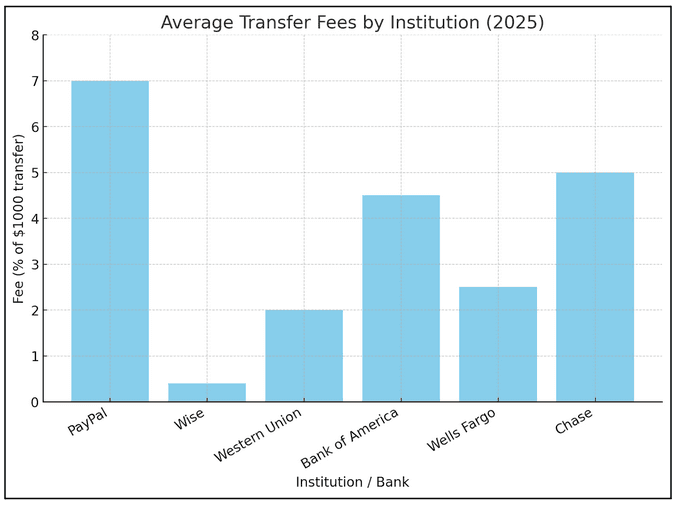
The chart above clearly highlights this issue. Across major institutions like PayPal, Chase, Bank of America, and Western Union, the average fee for a $ 1,000 transfer hovers around 3.6%. That means about $36 is lost on every transaction, not even accounting for hidden exchange markups or additional delays.
While some players, like Wise, offer more competitive rates, the overall picture shows a financial system in which intermediaries extract significant value simply for moving money from one place to another.
Stablecoins change this dynamic by enabling direct peer-to-peer payments without relying on banks or financial gatekeepers. With nothing more than an internet connection, users can transfer assets globally in seconds, without correspondent banks, approval delays, or inflated service charges.
This directness not only reduces friction but also extends access to people in regions where banking infrastructure is weak or exclusionary. By removing intermediaries, stablecoins return control of money to the individual, making financial transactions faster, simpler, and more inclusive.
Transactions: Lower Costs, Bigger Reach
In this section, we will discuss the financial benefits of using stablecoins instead of traditional payment methods for everyday needs.
One of the clearest advantages lies in the cost of moving money. Traditional payment methods, bank transfers, and remittance services all come with service fees that add up over time.
Stablecoins, on the other hand, operate on blockchain rails, where the only cost is the network transaction fee, an amount so small on blockchains like Solana that it becomes almost insignificant.
A USDC transfer on Solana averages less than $0.01 per transaction, regardless of whether you’re sending $10 or $10,000. This difference clearly isn’t minimal; it’s transformative, positioning stablecoins as the natural evolution of digital payments.
With banks, sending just $1 or $2 is impractical because the fee can swallow the payment. Stablecoins flip this logic on its head: sending small amounts costs no more than sending large ones.
In this way, stablecoin transfers don’t just reduce costs, they expand possibilities. By minimizing fees, they make small-scale financial transactions viable. This encourages new forms of economic activity and puts more money back into users’ hands rather than into middlemen’s.
Financial Control
Stablecoins empower users by giving them greater autonomy over their money, reducing reliance on traditional banks and intermediaries. Instead of entrusting funds to institutions that might restrict access, users can hold stablecoins directly and decide how and when to move their assets.
This control becomes even stronger when combined with self-custody solutions.
Key advantages of stablecoins include:
- Direct ownership of assets: Users don’t rely on banks that often impose limits on accounts.
- Self-custody options: Ensuring maximum independence with funds remaining secure even if centralized platforms fail.
- Global accessibility: Anyone with a smartphone and internet connection can store and send stablecoins without institutional approval.
Although self-custody gives users maximum control, it also comes with greater responsibility. Losing access to private keys or recovery phrases means permanently losing access to the funds, since there is no central authority to reset passwords or unlock accounts.
The responsibility is yours alone: protect your keys and never lose them… or else
Stablecoins in Everyday Shopping
Press enter or click to view image in full size
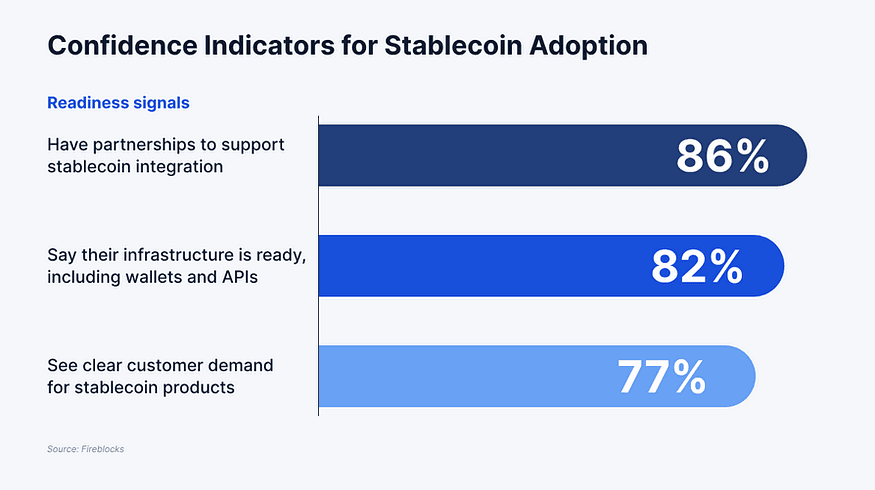
To begin this section, it’s worth highlighting this chart from Fireblocks that illustrates just how ready the financial industry is to bring stablecoins into mainstream payment systems. The survey gathered insights from 295 participants, most of whom were C-suite executives (61%), while the rest held senior roles.
These respondents came from a wide range of organizations, including traditional banks, challenger banks, cryptocurrency service providers, non-bank payment companies such as merchant account providers, and payment gateways.
The findings reveal that 86% of the participants reported having partnerships in place to support stablecoin integration, 82% say their infrastructure, wallets, and APIs included, are ready, and 77% see clear customer demand for stablecoin products. This combination of preparedness and demand shows that adoption is not just theoretical. The ecosystem is actively laying the foundations for stablecoins to transition from experimental pilots to full-scale, real-world payment solutions.
The practicality of stablecoins becomes most visible when applied to everyday spending. From groceries and restaurants to e-commerce platforms, stablecoins are increasingly being accepted as a form of payment. Merchants benefit from the speed and low fees, while consumers enjoy the simplicity of paying directly from their wallets.
Several key companies illustrate how this adoption is taking shape:
- Shopify: One of the biggest e-commerce platforms already allows merchants to accept stablecoin payments, letting shoppers check out with digital dollars just as easily as with a credit card.
- Kast: Through cards that can be added to a phone or requested in physical form, Kast enables users to spend stablecoins wherever traditional cards are accepted, both online and in person.
- Stripe: By adding stablecoin support to its payment infrastructure, Stripe enables merchants to accept digital dollars natively at checkout, helping bridge the gap between crypto and traditional payment rails.
These integrations create a seamless experience where stablecoin transactions feel indistinguishable from traditional payments, yet run on faster and much less expensive blockchain rails. Together, they show that stablecoins are moving beyond crypto-native platforms and becoming a practical tool for mainstream commerce.
Future Outlook: Mainstream Adoption Ahead?
As stablecoins continue to gain traction, the natural question is what the future of mainstream adoption will look like. One key factor shaping this discussion is the rise of Central Bank Digital Currencies (CBDCs). Governments around the world are exploring digital versions of their national currencies, which could streamline payments and modernize financial systems.
While CBDCs have the potential to expand the use of digital money, they raise concerns about centralization and surveillance, as control rests entirely with governments and central banks. This creates a contrast with stablecoins, which are issued by private entities but still retain the qualities of open, borderless blockchain assets.
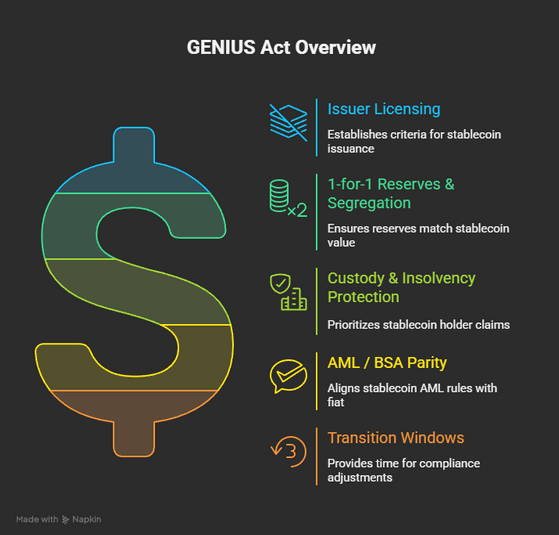
For stablecoins to reach widespread everyday use, several conditions must be met. The first is clear regulation, which provides certainty for businesses and consumers. A recent example is The Genius Act approved in the United States, a landmark piece of legislation designed to create a comprehensive framework for stablecoins. The Act focuses on ensuring proper reserves, transparency, and risk management among issuers, while also protecting consumers who rely on these digital assets for payments. By establishing standards, The Genius Act sets a precedent for how large economies might embrace stablecoins responsibly.
Another critical requirement is infrastructure development. Even with regulations in place, the underlying technology must be scalable, reliable, and secure. Wallets, APIs, and payment rails need to integrate smoothly so that stablecoin transactions feel as seamless as credit card swipes or bank transfers. The good news is that, as highlighted earlier, a majority of financial institutions are already ready on this front, with partnerships and systems in place to support integration.
Finally, merchant adoption will be the ultimate driver of mainstream adoption. For consumers, the ability to pay with stablecoins at their favorite shops, online platforms, and local businesses is what will normalize them as money rather than just a niche financial tool. Companies like Stripe and Shopify are paving the way, but broader acceptance will be necessary to cement stablecoins as part of daily commerce. By combining regulatory clarity, strong infrastructure, and widespread merchant adoption, stablecoins are on track to solidify their role in the global financial system. What began as a speculative corner of crypto is now positioning itself as the backbone of a new era of money, borderless, efficient, and built for everyday use.
The shift isn’t coming someday in the distant future; it’s already unfolding right in front of us.
Making Your Stablecoins Work for You
Stablecoins are already proving themselves as faster, cheaper, and more reliable than traditional money. They save users on fees, cut out bureaucracy, and are increasingly accepted in everyday shopping. But the story doesn’t end with payments. One of the most overlooked advantages is that stablecoins can earn yield instead of sitting idle in your wallet.
Platforms like Neutral Trade, along with others in the DeFi space, are expanding on this idea. Through products such as NT Earn and JLP Delta-Neutral, users can access yield products designed to grow their balance.
This transforms stablecoins from a tool of convenience into a tool of growth. They’re not only borderless and efficient, they’re productive.
Website: https://www.neutral.trade/ · Docs · X · Discord · Telegram