Delta Neutral Arbitrage: A Deep Dive Into the Strategy
The three strategies Delta Neutral Arbitrage runs, where the return comes from, the asset profile, and how risk is managed, explained by curator Velox Trading Group with live vault data.
Delta Neutral Arbitrage has posted a positive return in every full month since it went live on 15 May 2026. This post explains what the vault actually does, where its return comes from, what it trades, and how its risk is managed.
We asked the curator, Velox Trading Group, to explain the strategy in their own words. Their answers are quoted below, with the live vault data alongside.
Who is Velox?
Velox Trading Group is a quantitative digital asset trading firm founded in 2021. The team is made up of HFT traders, engineers, mathematicians and data scientists. In their words:
"We do one thing: delta neutral trading, run through every market cycle since launch, for our own fund and for institutional managed accounts in both USD and BTC. Every part of the stack is proprietary and built in house, from execution and market selection to the automated risk systems that monitor and rebalance positions around the clock."
Each venue Velox trades on has to pass its own scored due diligence framework before it receives capital, and exposure to the venue is capped by that score.
What "delta neutral" means here
Every position in the vault is paired with an equal and opposite position in the same asset. The return does not depend on the price of that asset going up or down.
Velox describes this as a stricter standard than market neutral. In a market neutral portfolio, longs and shorts are held in different assets, so the portfolio is still exposed to how those assets perform relative to each other. In a delta neutral portfolio, the hedge is in the same asset, so that relative-performance exposure is removed.
The three strategies
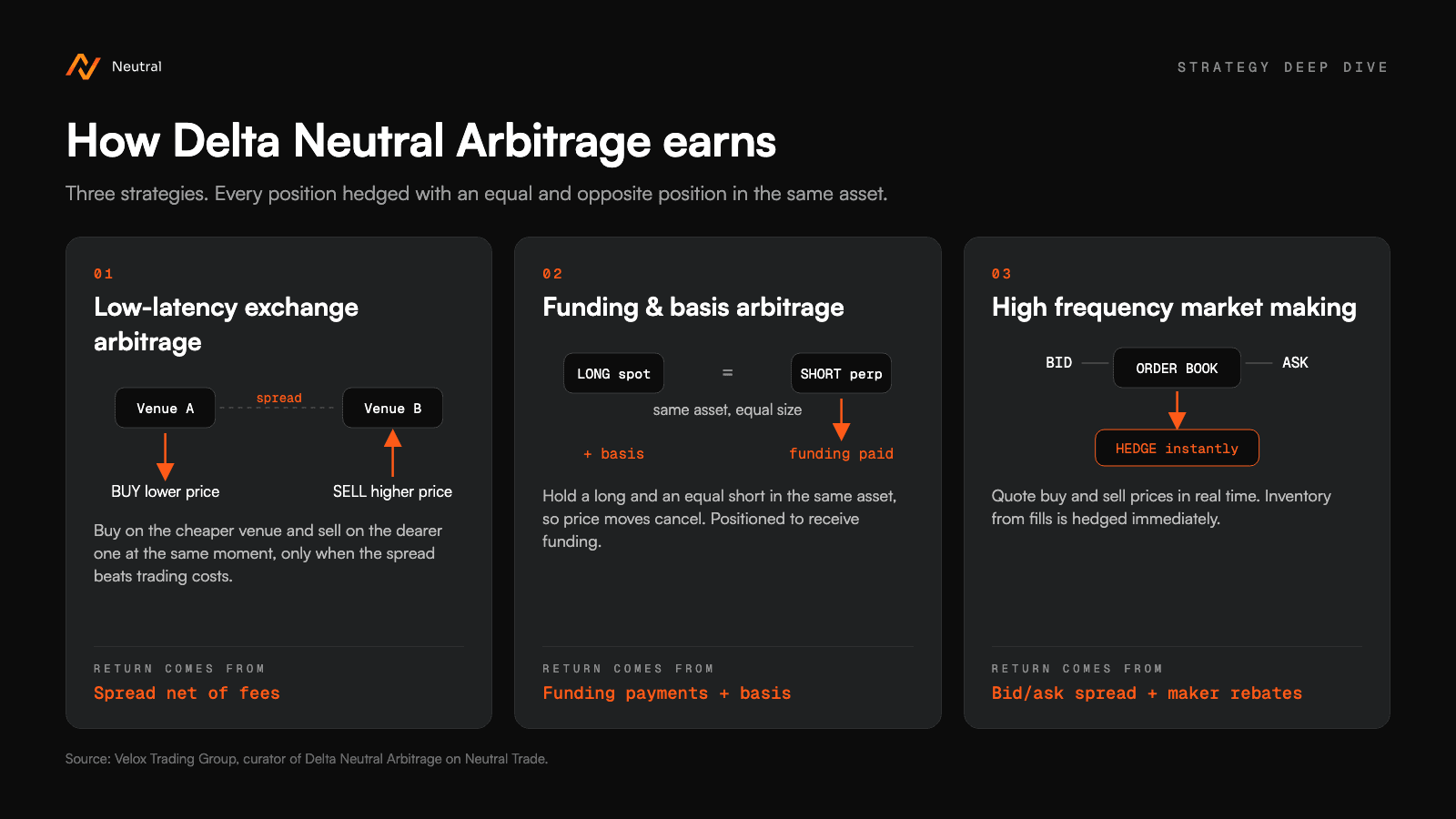
The diagram below summarises the three strategies and the source of return for each.
1. Low-latency exchange arbitrage
The vault captures price spreads on the same instrument across venues. When the spread between two venues is wider than trading costs, it buys on the lower-priced venue and sells on the higher-priced venue at the same moment.
Where the return comes from: the spread, net of fees, earned with no directional exposure.
2. Funding and basis arbitrage
The vault holds a long and an equal short in the same asset. That can be spot against a perpetual, or a perpetual against a perpetual, so price moves cancel out.
The return comes from the funding payments and from the price gap (the basis) between the two legs. When funding is positive, longs pay shorts. When it is negative, shorts pay longs. Velox positions the strategies to be on the receiving side.
Where the return comes from: funding payments plus basis.
3. High frequency market making
The vault continuously quotes buy and sell prices on exchange order books and updates them in real time as the market moves. Inventory from fills is hedged immediately, so the book stays delta neutral.
Where the return comes from: the bid/ask spread and maker rebates, earned across a large number of small trades.
The asset profile
The vault mainly trades the top 200 assets by market cap. Allocation scales with size and liquidity: larger assets are allowed larger allocations, and smaller assets are capped at lower limits. The maximum exposure per asset is further adjusted for ADL risk, open interest and volatility.
Velox puts the capacity of the strategy at roughly $100M on the current set of venues and markets. Capacity grows with the number of venues and markets traded.
How risk is managed
Velox names three main risks and how each is addressed.
ADLs and liquidations. Every market is screened before deployment. Automated systems rebalance collateral and rehedge around the clock. A low-latency ADL signal monitors each venue in real time and reduces or closes positions when ADL risk rises.
Adverse funding. Positions are diversified across many assets and venues, with per-position limits. This caps the impact of any single market turning.
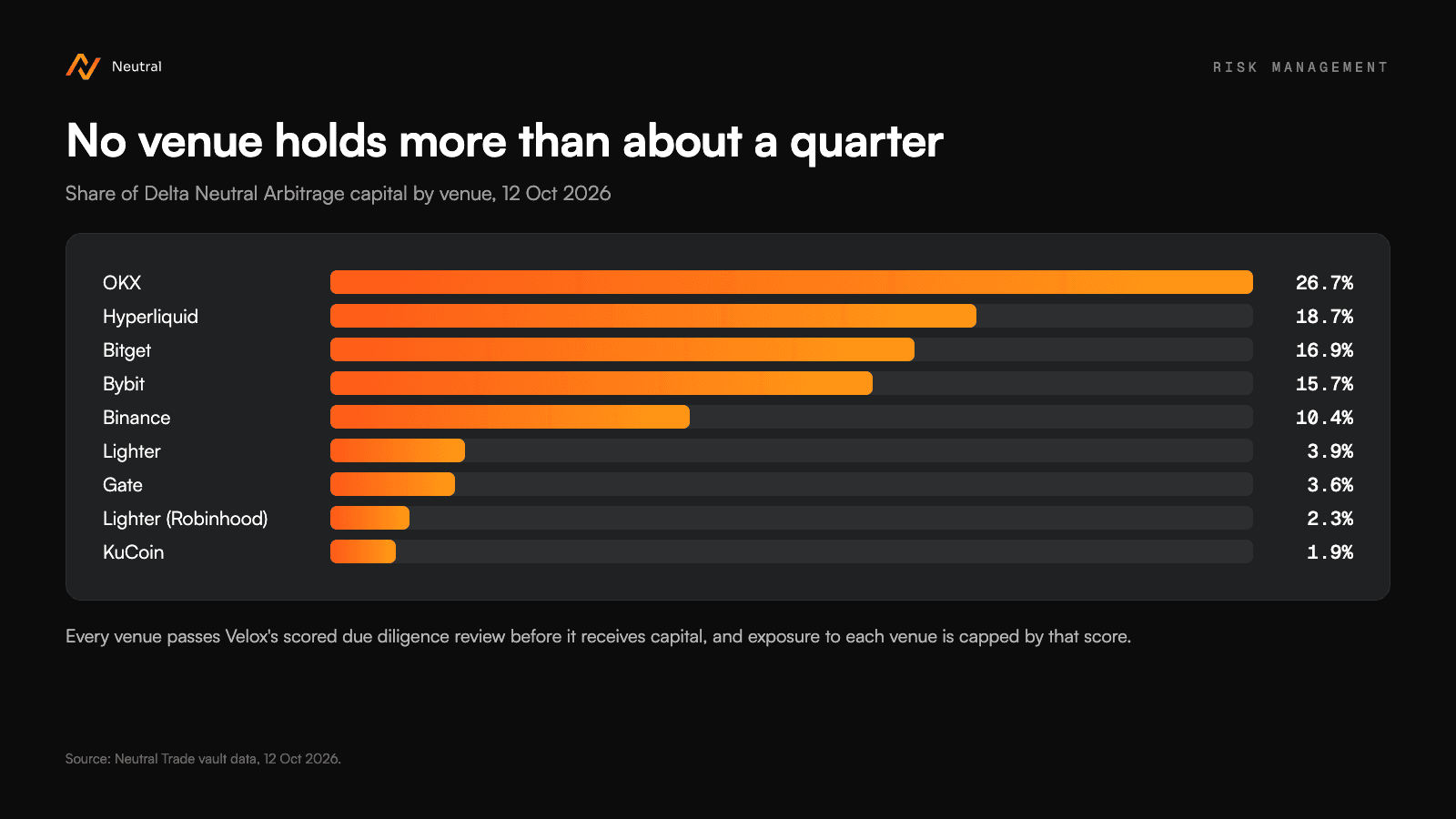
Counterparty exposure. Every venue goes through a scored due diligence review that is updated periodically. Exposure per venue is capped based on its score.
The vault's capital is spread across nine venues. As of 12 October 2026, the largest share on any one venue was 26.7%.
What the vault has done so far
The vault went live on 15 May 2026. It has returned +0.69% in June, +0.45% in July, +1.15% in August and +0.75% in September. Each of those months is positive.
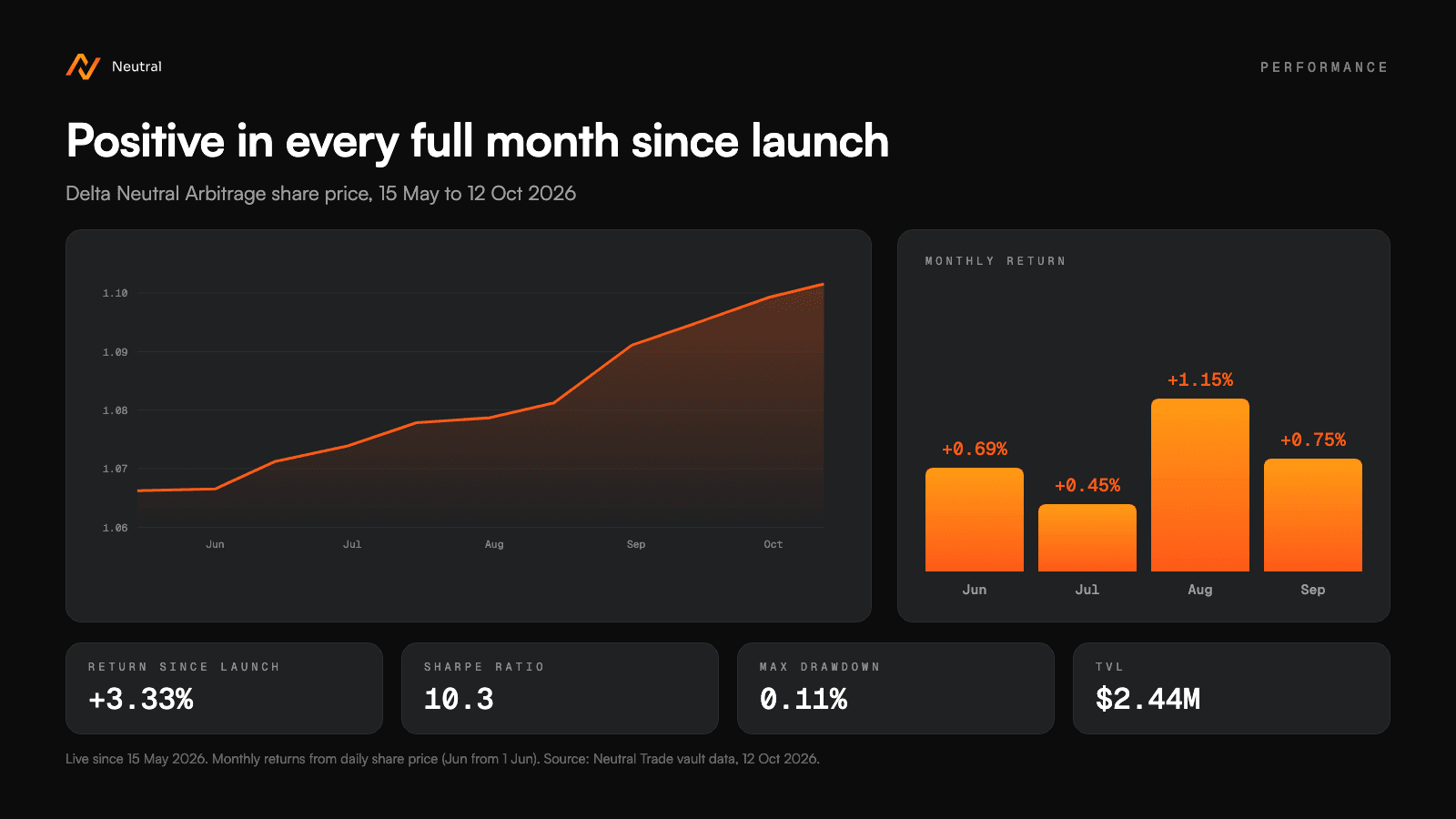
As of 12 October 2026, the vault shows:
- A return since launch of 3.33%
- A Sharpe ratio of 10.3
- A maximum drawdown of 0.11%
- $2.44M in TVL
These figures are measured over under five months, so the track record is short. Read them as an early record of how the strategy behaves, not as a forecast.
Deposit in Delta Neutral Arbitrage
You can see the live performance, venue allocation and curator details on the strategy page.
This is the first post in our strategy deep dive series. Read more on the Neutral Trade blog.