How to Read a Vault Like a Professional
How professional allocators read Sharpe, max drawdown, funding rates, on-chain NAV, and the custody chain — with live Neutral Trade examples.
Every month we publish short explainers on X about how professional allocators evaluate strategies. Here are July's lessons in one place, with live numbers from our own vaults as the examples.
Lesson 1: APY Is the Destination. Drawdown Is the Ride.
A high APY tells you where the strategy might take you. Max drawdown tells you how bumpy the road was — the worst peak-to-trough dip so far, the most you could have been down if you had entered at the exact top.
Always read them together. A modest yield with a 0.1% worst dip is a fundamentally different product from a 35% target with a 15% worst dip — not better or worse, but different, and suited to different capital.
Two live examples from our own lineup make the point:
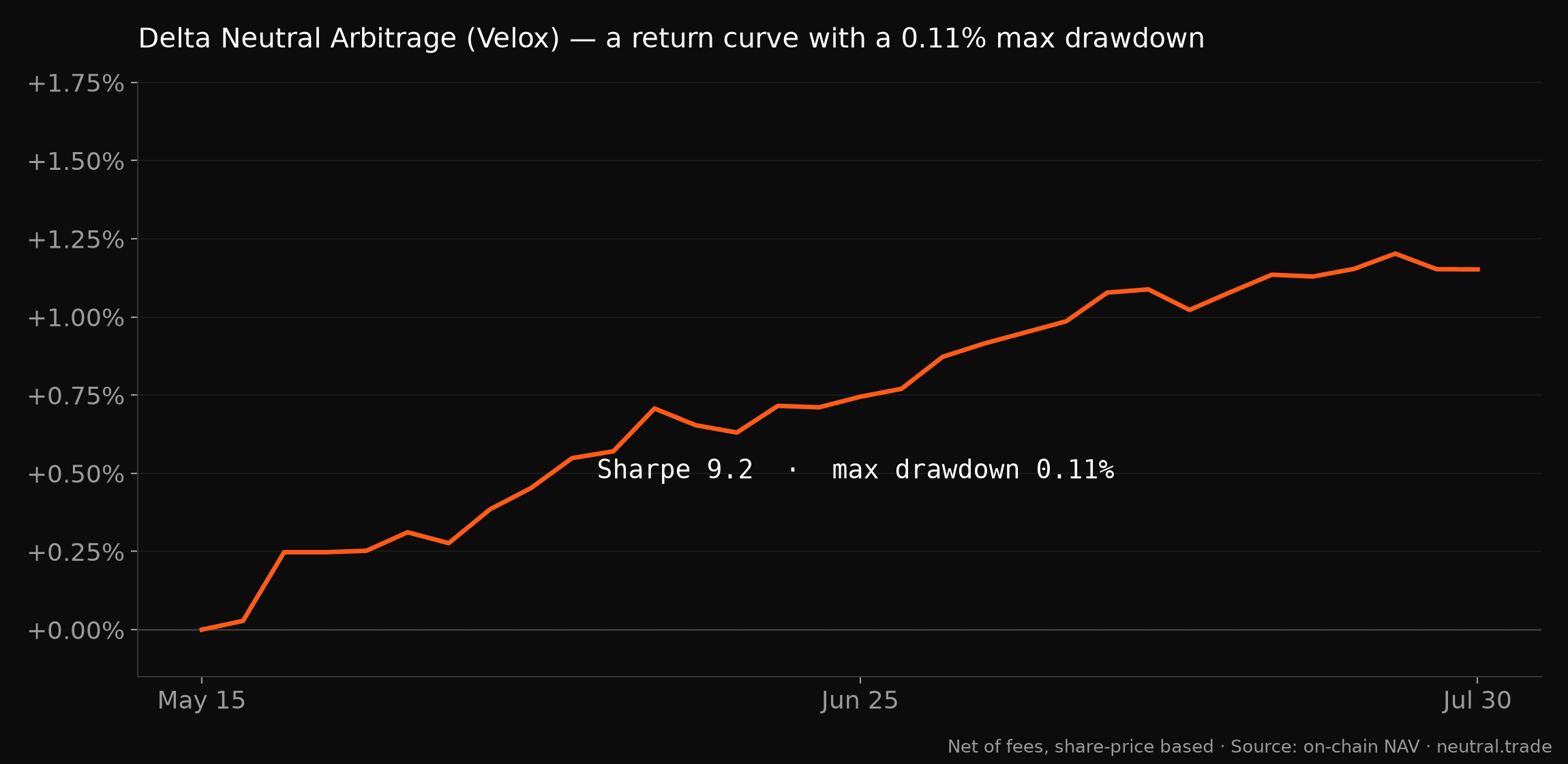
- Delta Neutral Arbitrage (Velox): +1.19% net since May 15 — a roughly 6% annualized pace — with a max drawdown of 0.11%. The ride barely registers.
- Options Market Making (Xanthas): the firm targets 35% APY, with a max drawdown around −15% on its pre-platform, exchange-verified track record — and it has already printed a 6.82% drawdown in five weeks on our platform. A real return engine, but you feel the road.
Low drawdown has a compounding benefit that is easy to miss: your balance rarely dips below where it started, so compounding is never interrupted.
Read the original thread on X →
Lesson 2: Sharpe Ratio Is Return Per Unit of Risk
Sharpe ratio answers one question: how much return did each unit of volatility buy you?
A Sharpe of 1 is respectable. Above 2 is strong. When you see a vault print a Sharpe of 9 — as Velox currently does at 9.2 — it means the equity curve has been remarkably smooth, not just high. Smoothness is evidence of a repeatable process rather than a lucky directional bet.
Two caveats that matter more than most people realize. First, compare Sharpe only within a strategy type: our delta-neutral Velox vault prints 9.2 while our directional Systematic Alpha prints 1.4, and that gap says almost nothing about which is better run — it says they are different products with different risk shapes. Second, Sharpe depends on an assumed risk-free rate, which is why every vault page now shows you the rate used in the formula rather than asking you to trust the output.
This month we also added the Sortino ratio to every vault's analytics. Sortino is Sharpe's sharper cousin: it penalizes only downside volatility. Upside surprises don't count against the strategy — which matches how you actually experience risk.
Read the original thread on X →
Lesson 3: Funding Rates Are a Harvestable Yield Source
Perpetual futures exchanges charge funding — a periodic fee that keeps the perp price pinned to spot. On Hyperliquid, it accrues every hour. Whoever is on the crowded side of the trade pays it; whoever takes the other side collects it.
That payment stream is not a gimmick. It is the fee leveraged traders pay for their leverage, and it can be harvested systematically: hold the asset, short the perp against it, collect funding while price exposure cancels out.
That is the entire engine of our Hyperliquid Funding Arb vault — market-neutral by construction, +10.81% cumulative since June 2, 2025, with a max drawdown of 0.22%. The yield comes from an identifiable counterparty paying an identifiable fee. When someone cannot tell you where a yield comes from, that is when you should worry.
Read the original thread on X →
Lesson 4: A Track Record You Can Verify Beats One You Must Trust
Every deposit, withdrawal, and NAV update on Neutral Trade settles on Solana. That sentence sounds technical, but its consequence is simple: you do not have to take our word for any number we publish.
Traditional funds report performance quarterly, audited annually, with the raw data private. Our vaults publish NAV in real time, position breakdowns, and monthly returns since inception — gross and net — and the underlying settlement trail is public infrastructure.
This is also why we run every new strategy with our own treasury before opening it to the public. Systematic Alpha traded Neutral Trade's own capital for eight weeks before launch. The track record you see was earned live — not modeled, not backtested.
Read the original thread on X →
Lesson 5: Know Where Your Money Physically Goes
The question that should follow "how does this earn?" is "where does my money actually sit while it earns?" Most yield products answer that badly. Here is our answer, step by step.
1. Your wallet → the vault. You deposit USDC from your Solana wallet into a Neutral Strategy Vault smart contract. Your shares, fees, and lockups are tracked on-chain, in contracts audited three times — by Offside Labs, Quantstamp, and Halborn.
2. The vault → pre-approved venues only. Transfers are signed by an MPC quorum — no single person, including anyone at Neutral Trade, can move your funds to an arbitrary wallet. Capital moves only between pre-approved venues: centralised exchanges via Ceffu or Copper off-exchange custody and settlement, on-chain DEXs, and TradFi venues.
3. The trading firm never holds it. This is the part worth internalising. Curators get exactly two permissions: place orders and read balances. They can trade the strategy. They cannot withdraw your funds, and they cannot move them outside the approved perimeter. The separation is enforced by the architecture, not by a promise in a terms document.
The general lesson generalizes beyond us: when you evaluate any yield product, ask who can move the money and what stops them. If the answer is "trust us," you have your answer.
Read the original thread on X →
All performance figures net of fees, share-price based, as of July 30, 2026. Past performance does not guarantee future results.
Want these explanations inside the product? Tap any metric on any vault page — every number on Neutral Trade now explains itself in plain English. Start at neutral.trade/strategies.