Neutral Autopilot: An Intelligent Capital Management Layer for Unified CeDeFi Operations
Behind the single unified account: multi-exchange liquidity integration, separated custody and execution permissions, automated cross-platform capital allocation, and NAV risk controls.
Neutral Autopilot is the core capital management layer of Neutral.
User assets are deposited into Neutral Autopilot, where they are recorded under a unified accounting system and allocated across different exchanges and on-chain venues based on strategy requirements. Capital allocation, NAV calculation, risk management, and deposit/withdrawal processes are all coordinated through Neutral Autopilot.
For users, it appears as a single unified account. Behind the scenes, it operates as a capital management infrastructure connecting CeFi and DeFi markets.
1. Multi-Exchange and On-Chain Liquidity Integration
Neutral Autopilot is not tied to a single trading platform. Instead, it provides a unified management framework across multiple liquidity venues.
Currently supported:
- CEX: Binance, OKX, Bybit, Bitget, Gate, KuCoin
- On-chain: Hyperliquid, Lighter, and more
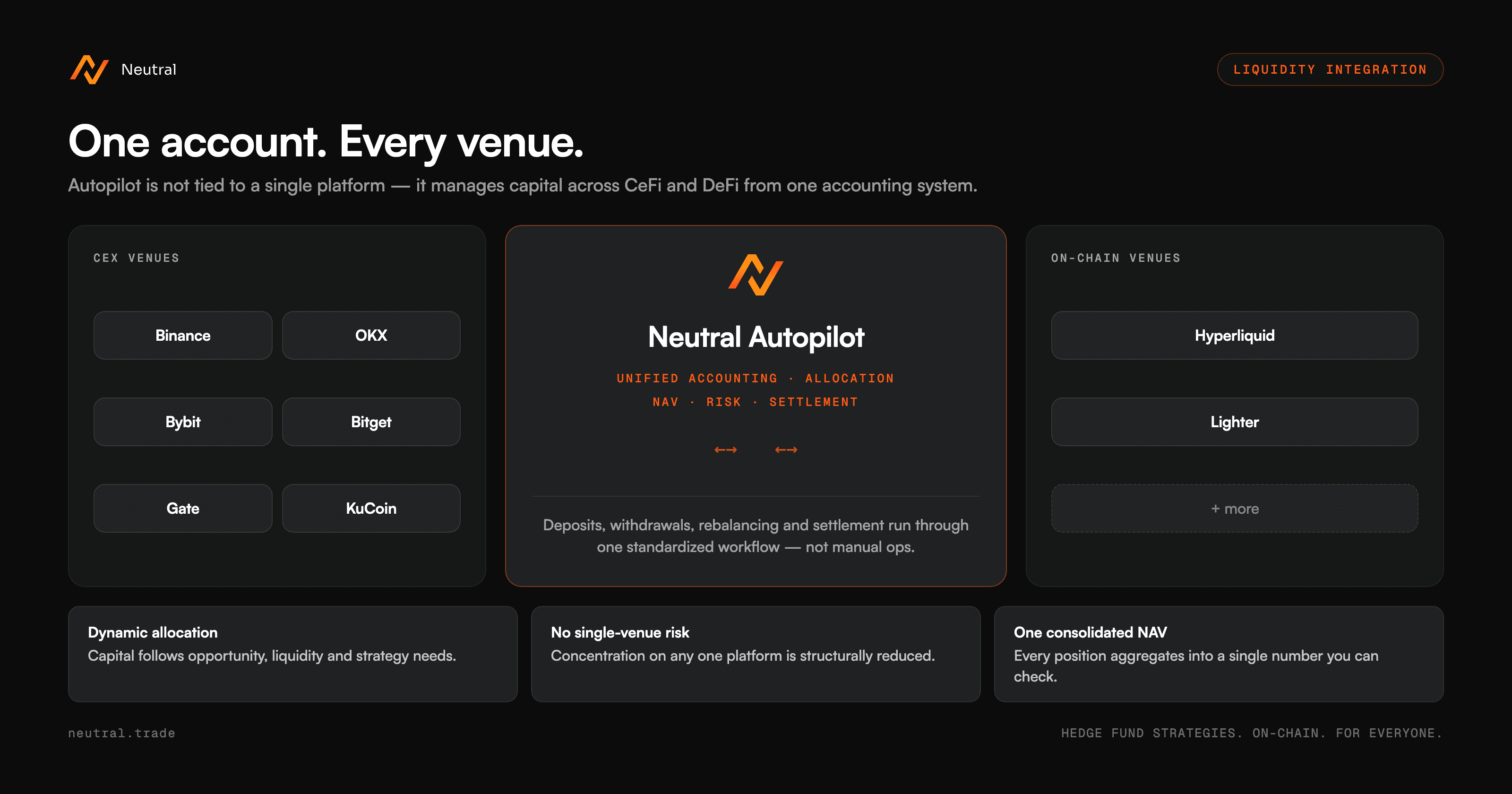
By connecting different types of liquidity venues, Neutral Autopilot enables:
- Dynamic capital allocation across multiple platforms based on market opportunities, liquidity conditions, and strategy requirements;
- Reduced concentration risk from relying on a single platform or strategy;
- Unified aggregation of strategy assets and performance into a consolidated NAV.
Capital movements across platforms are not dependent on manual operations. Instead, deposits, withdrawals, rebalancing, and settlements are executed through a standardized capital management workflow.
2. Separation of Custody, Execution, and Signing Permissions
Asset security depends not only on where funds are stored, but also on how access and control permissions are structured.
Neutral Autopilot separates asset custody, trading execution, and signing authority through a layered architecture, ensuring clear boundaries between capital control and strategy execution.
- CEX custody — assets on centralized exchanges sit with qualified custody providers: Binance via Ceffu; OKX, Bybit, Bitget and others via Copper. Trading teams hold trading permissions only.
- On-chain signing — on-chain transactions and capital movements run through a Fordefi MPC wallet. Trading teams execute capital operations through Neutral's internal infrastructure without ever directly holding private keys.
- Unified accounting and settlement — Neutral Autopilot itself, as a Solana smart contract.
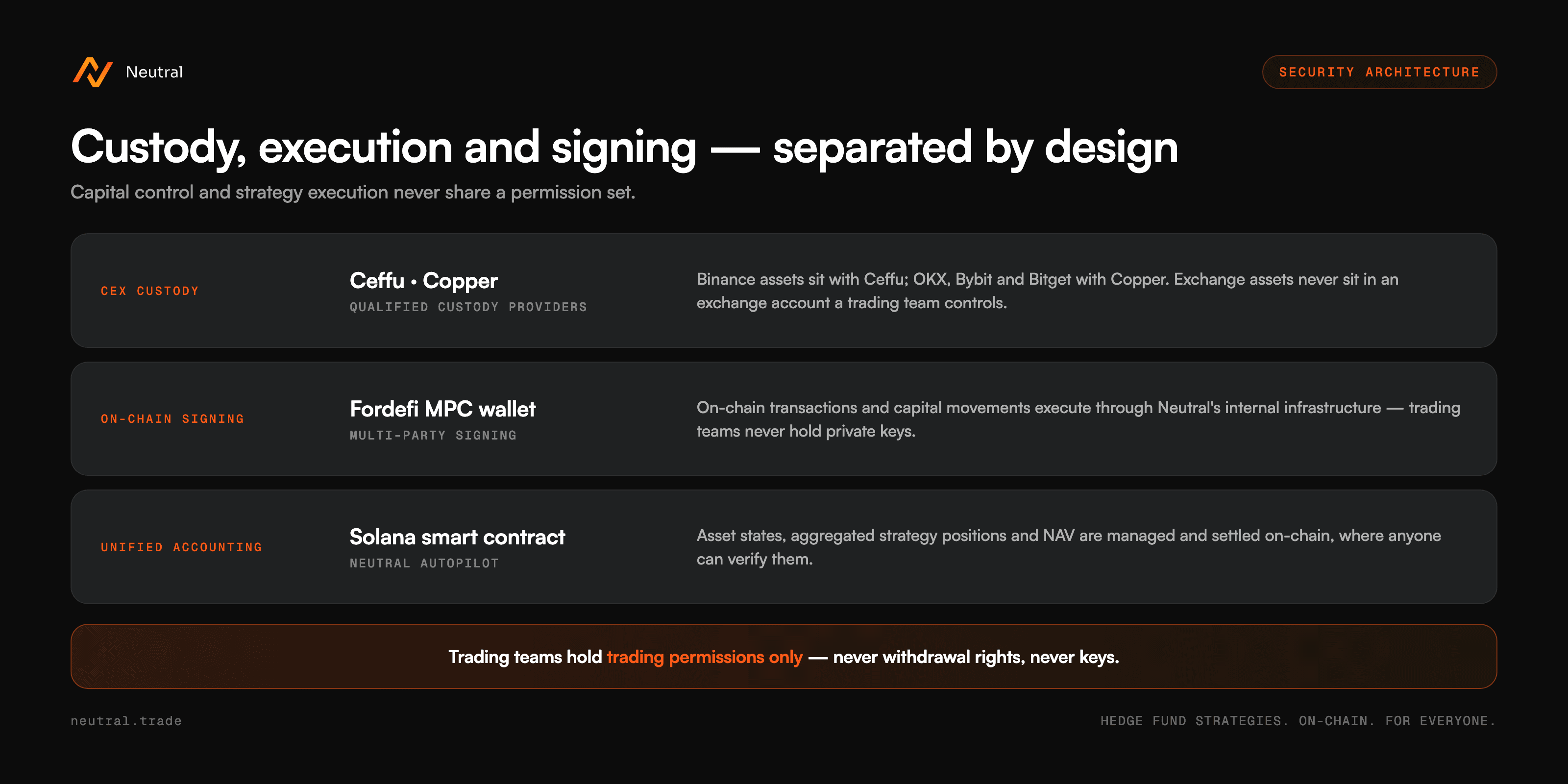
This architecture separates capital management from trading execution:
- CEX assets are secured through professional custody providers;
- On-chain operations are executed through MPC-based multi-party signing;
- Neutral Autopilot manages asset states, aggregates strategy positions, and calculates NAV.
The trading team focuses solely on strategy execution, while capital movements remain governed by permission controls and operational procedures.
3. Cross-Chain and Cross-Platform Capital Allocation
In real trading environments, capital continuously moves between different venues as strategies operate and adjust.
For example:
- Idle capital remains within Neutral Autopilot;
- When strategies require additional allocation or position adjustments, capital is deployed to corresponding exchanges or on-chain accounts;
- When users request withdrawals, assets are routed back to Neutral Autopilot for settlement.
The entire process is powered by Neutral's internal automated infrastructure rather than manual operations.
Typical workflow:
- 1. Idle capital is centralized within Neutral Autopilot;
- 2. Capital is allocated to different strategy vaults based on portfolio optimization models;
- 3. The execution system moves funds between exchange custody accounts and on-chain wallets according to capital signals;
- 4. Assets across different chains and trading platforms are ultimately aggregated back into Neutral Autopilot for unified NAV calculation.
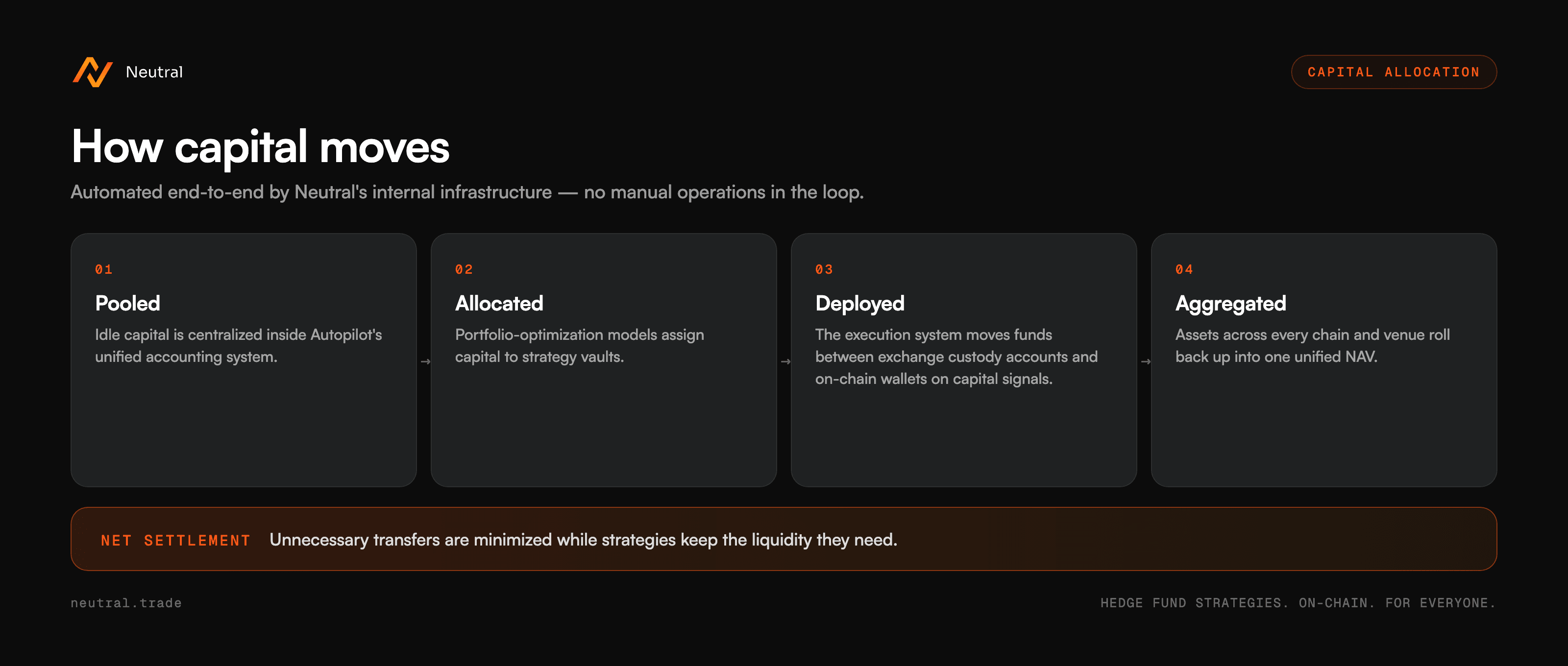
The system adopts a Net Settlement approach to minimize unnecessary capital transfers while maintaining sufficient liquidity for strategy execution.
4. NAV Calculation and Oracle Risk Controls
The NAV of Neutral Autopilot directly determines user deposit and withdrawal pricing. Therefore, price updates must undergo strict validation.
Each NAV update follows a predefined process:
- 1. Pause new deposit and withdrawal requests;
- 2. Aggregate strategy-level asset values;
- 3. Calculate the latest NAV;
- 4. Update Oracle data;
- 5. Process pending deposits and withdrawals;
- 6. Resume normal operations.
During the update process, the system performs multiple risk checks, including:
- Multi-party verification of Oracle prices against actual asset values;
- Monitoring whether NAV changes exceed predefined thresholds;
- Validating Oracle data freshness;
- Confirming the validity of strategy-level asset data.
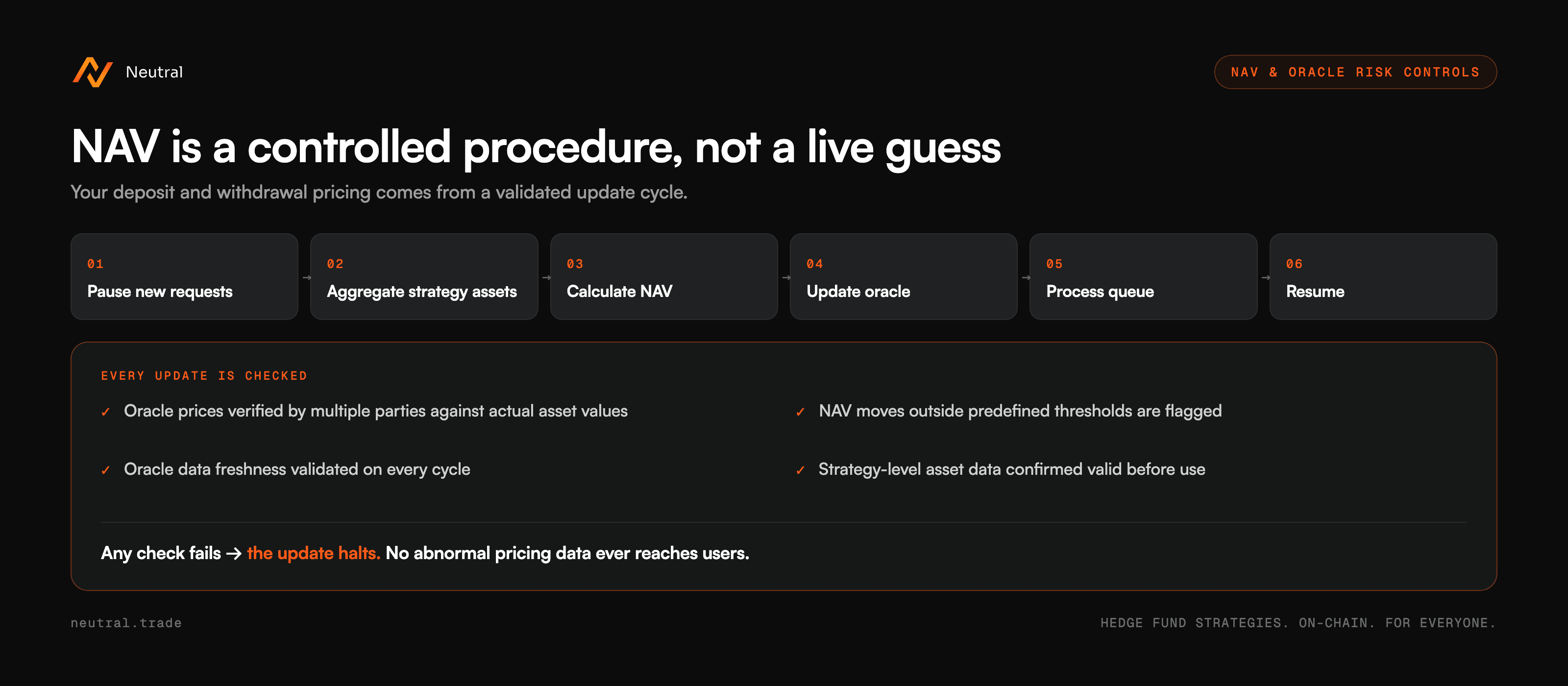
If any validation fails, the system will halt the update process and require further verification rather than continuing with abnormal pricing data.
Summary
Neutral Autopilot is not simply a vault. It is a capital management infrastructure designed by Neutral for the CeDeFi ecosystem.
It provides:
- Unified management of assets across multiple exchanges and blockchains;
- Connectivity between CeFi and DeFi liquidity venues;
- Separation of asset custody, trading execution, and signing authority;
- Automated cross-platform capital allocation;
- Unified NAV calculation with rigorous risk controls to ensure pricing reliability.
Users interact with a single unified account, while the system manages real assets distributed across multiple exchanges, blockchains, and trading strategies.
Start earning with Autopilot →