Neutral Autopilot: The On-Chain Multi-Strat Vault
Where the yield actually comes from, how a trading firm earns a place in the portfolio, and why we run many managers instead of one - the 30-year-old model we're porting on-chain.

Neutral Autopilot went live this week: one deposit, allocated across our live market-neutral strategies, rebalanced as conditions change.
In the launch article I covered what makes our vaults structurally different from the rest of the yield market: custody, fee fairness, verified reporting, contained risk. This one is about the machine underneath. Where the yield actually comes from, how a trading firm earns a place in the portfolio, and why we run many managers instead of one.
We Originate the Yield
This is the part I care most about, and it's the part hardest to see from outside.
Most yield products are shopping. They scan the market for the best available rate, route capital into it, and take a cut for the routing. There's nothing dishonourable about that business, but be clear about what you're buying: a middleman taking the easiest route to maximize APY without caring about the risks. How many curators got hit by supplying lend liquidity to Stream Finance and USR? Did they supply because they did the hard work of due diligence, or did they supply because the APY is high?
We are not in that business. We build the quant infrastructure, we onboard real trading teams, and we deploy our own risk limits, vault logic and leverage mechanics. We are not curating yield opportunities. We are manufacturing alpha.
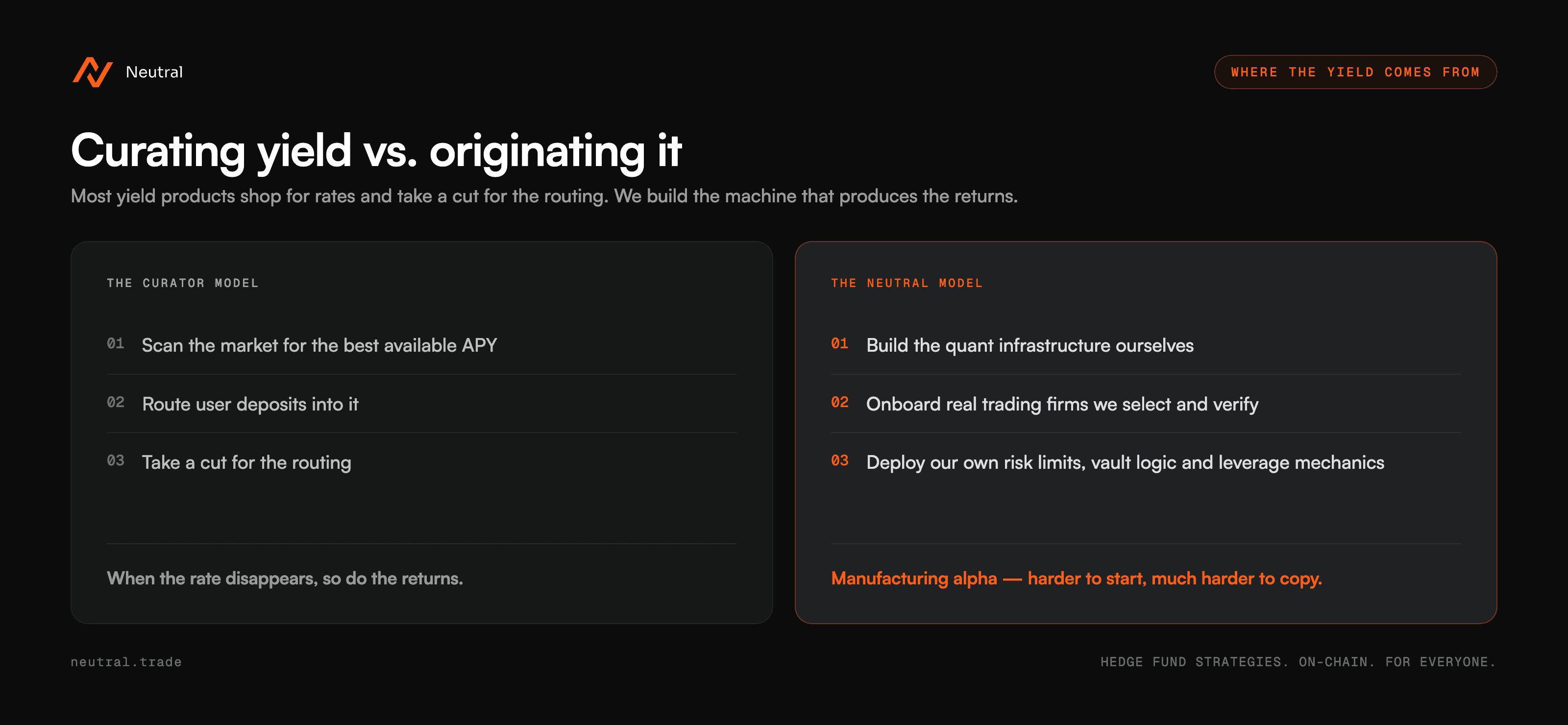
The difference shows up when conditions turn. A curator's returns disappear the moment the rates they were shopping for disappear. Ours come from strategies we built the machinery for, run by desks we selected, inside limits we wrote. That is a harder business to start, and a much harder one to copy.
How a Strategy Earns Its Place
"Desks we selected" is doing a lot of work in that sentence, so let me open up the selection too.
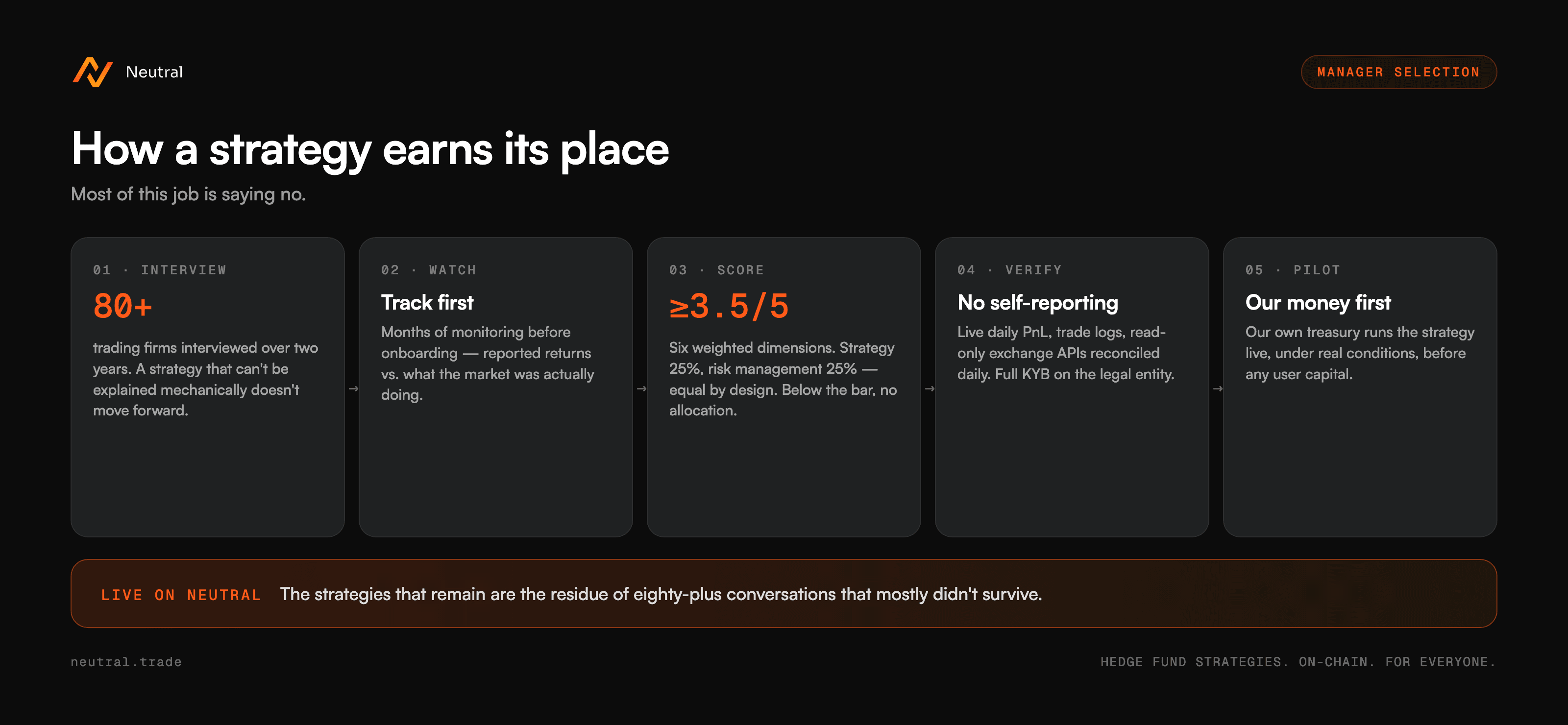
Over the past two years we've interviewed more than 80 trading firms. For most of them, the conversation didn't end with a yes or a no. It ended with us watching. We track the performance of firms we haven't onboarded, sometimes for months, comparing what they report against what the market was actually doing, and building an understanding of where their returns really come from. A strategy that can't be explained to us in mechanical detail (what it trades, why the edge exists, who's on the other side) doesn't move forward, no matter how good the numbers look.
The firms that do move forward go through a standardized scoring framework: six weighted dimensions, and the weights tell you what we care about. Strategy and track record is 25%. Risk management is another 25%. Equal weight, and that's deliberate: a brilliant strategy with undefined leverage limits fails, because we've seen how that movie ends. The rest covers infrastructure and technology, operational maturity (single-operator teams get heightened key-person scrutiny, a lesson this industry keeps re-learning), counterparty and legal standing, and portfolio fit. Minimum passing score: 3.5 out of 5. Below that, no allocation, however promising the pitch.
And the verification is the part I'd underline. Backtests alone are never sufficient. We require live track records with daily PnL and timestamps, historical trade logs, and read-only exchange API access that we reconcile daily. Self-reported spreadsheets are not accepted as evidence of anything. Every firm goes through full KYB on the legal entity: beneficial ownership, regulatory standing, reference checks with their existing investors and exchanges. An unverifiable track record blocks onboarding outright, regardless of how well the firm scores everywhere else.
And even after a firm passes every gate, we are still not done. Before anything earns user capital, we put our own treasury behind it and run it live for a meaningful period, under real market conditions and real operational scrutiny. That is where strategies prove whether they are actually durable, not just persuasive on paper. Some do not survive that stage, and it means we have taken losses ourselves on strategies that didn't hold up so our users don't have to.
Some of our firms operate under publication aliases. Their commercial agreements prevent public disclosure of their legal names. The alias governs what we publish. It does not govern what we verify: the KYB, the track-record checks and the daily reconciliation all run against the real entity.
Most of this job, it turns out, is saying no. The strategies on Neutral are the residue of eighty-plus conversations that mostly didn't survive the process.
One Manager Is a Bet. A Portfolio of Managers Is a System.
This is the actual argument for Autopilot over every single-strategy, single-manager product on the market.
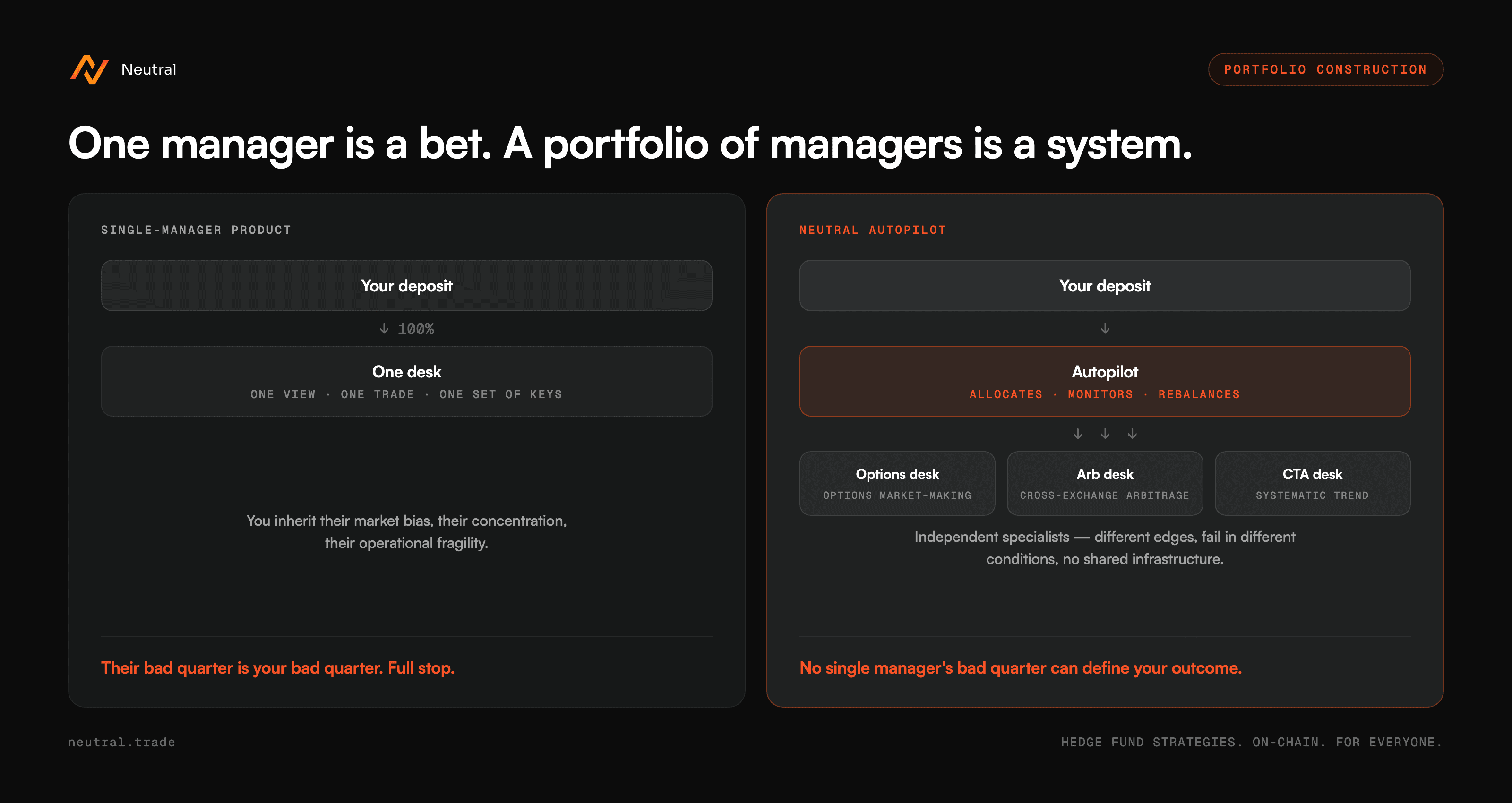
When you deposit into a single-manager product, you inherit everything about that manager: their bias about where the market is going, their concentration in the trade they know best, and their operational fragility. One desk, one set of keys, one team having one bad quarter. The manager doesn't have to be dishonest for this to hurt you. They just have to be human. Every manager has a view, and every view is sometimes wrong; when your entire deposit sits behind one view, their bad quarter is your bad quarter, full stop.
We built the opposite structure. Autopilot allocates across multiple independent trading firms, and each one is a specialist: the options desk does options market making, the arbitrage desk does cross-exchange arbitrage, and nobody is asked to be good at everything. Their strategies come from different edges, fail in different conditions, and share no infrastructure, so no single manager's bias, blow-up or bad quarter can define your outcome.
And the selection isn't just "collect good strategies". Because we track a much larger basket of firms than we onboard, every candidate is evaluated against the portfolio, not in isolation. We run cross-portfolio analysis on correlation, asset overlap and diversification benefit before anything goes live. We will often choose a genuinely uncorrelated niche strategy over a bigger, flashier one that overlaps with what we already run. The question is never "is this strategy good?" It's "does the portfolio get better when we add it?"
Those are two different questions, and the second one is the entire discipline of multi-strategy investing.
The Model We're Copying Is 30 Years Old
None of this is a new idea. We didn't invent it. We're porting it.
Millennium runs over $90 billion, and it is not one fund running one strategy. It's a city of hedge funds under one roof. Dozens to hundreds of autonomous portfolio managers each run their own book (quant, stat arb, global macro, credit, trend, vol) while the firm enforces strict risk controls on every pod: defined drawdown limits, leverage caps, real-time PnL monitoring. The firm provides the full infrastructure: execution, back office, compliance, reporting, data and fundraising. The PM does exactly one thing: generate alpha. And capital moves dynamically toward the pods that earn it, based on historical performance, strategy capacity and risk-adjusted returns.
The result is a diversified, risk-controlled engine that keeps delivering to its investors across market cycles.
Now read that paragraph again. Independent trading teams. Risk limits enforced by us rather than promised by them. Capital allocated dynamically on performance and capacity.
That is Neutral Autopilot: the multi-strategy architecture, applied on-chain. Side by side:
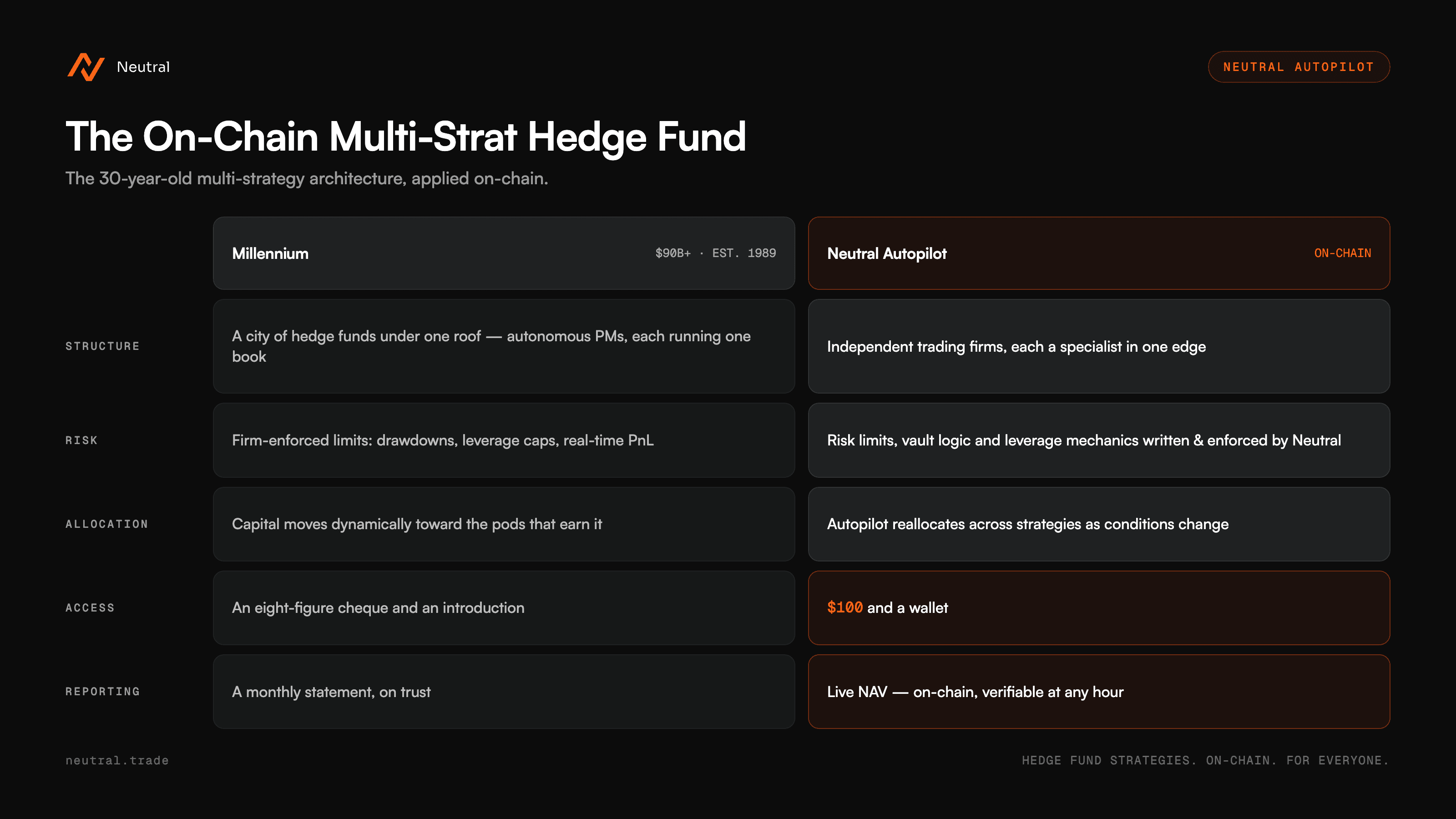
With two differences. Millennium's investors need an eight-figure cheque and an introduction to somebody. Ours need $100 and a wallet. And Millennium's investors wait for a monthly statement. Ours can check the NAV live.
CeFi Execution. DeFi Transparency.
The trades happen where the liquidity actually lives: major centralised venues, with real depth and real execution quality. Pretending otherwise costs users money in slippage, and we're not interested in paying that tax for the sake of appearances.
The accounting, though, happens on-chain, where you can check it. Our vaults are on-chain. PnL is on-chain. The track record is on-chain: transparent, verifiable and auditable, by you, at any hour, without asking us for anything.
Traditional asset management sends you a monthly statement and asks for your trust. We give you a block explorer.
It's asset management, rebuilt for the internet.
Millennium took three decades to prove the model. We're taking the same architecture to everyone with $100 and a wallet.
Start earning with Autopilot →