Key Design Considerations for Neutral Autopilot
Co-Founder & CEO Derek Lee on what sits underneath Autopilot: custody that never leaves the vault, individual high-water marks, verified reporting, and why we picked fair over simple.
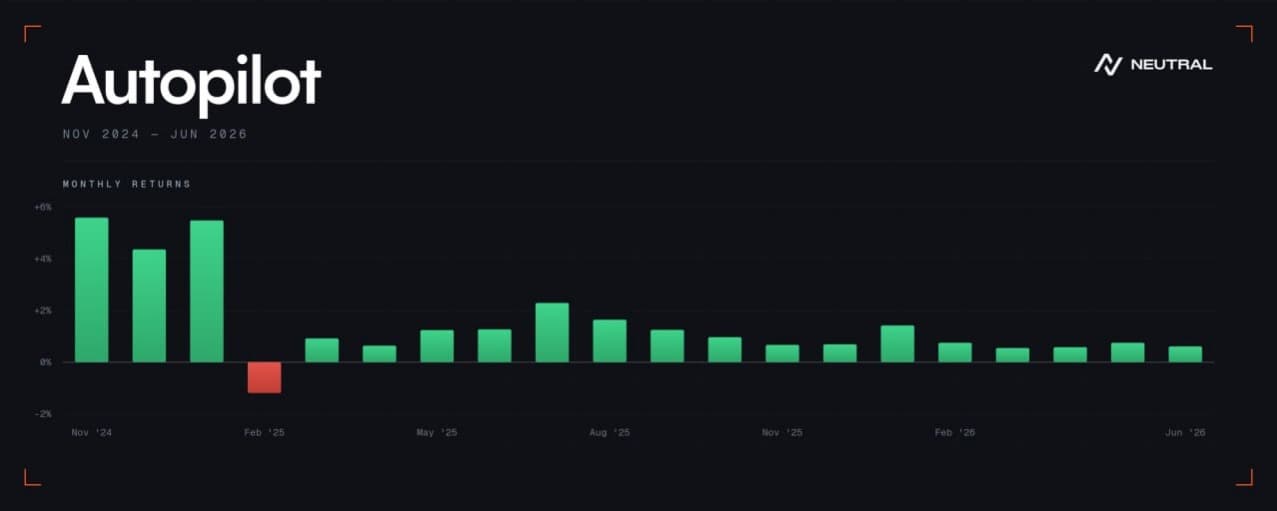
After running Neutral Trade with 2 years of on-chain track record on Solana, here's what we realised: from a depositor standpoint, picking the right strategy is difficult. You have to learn each one, track how it performs, judge every drawdown, and know when to switch.
That is a problem we created. We kept listing good strategies, and each new one made the decision harder instead of easier.
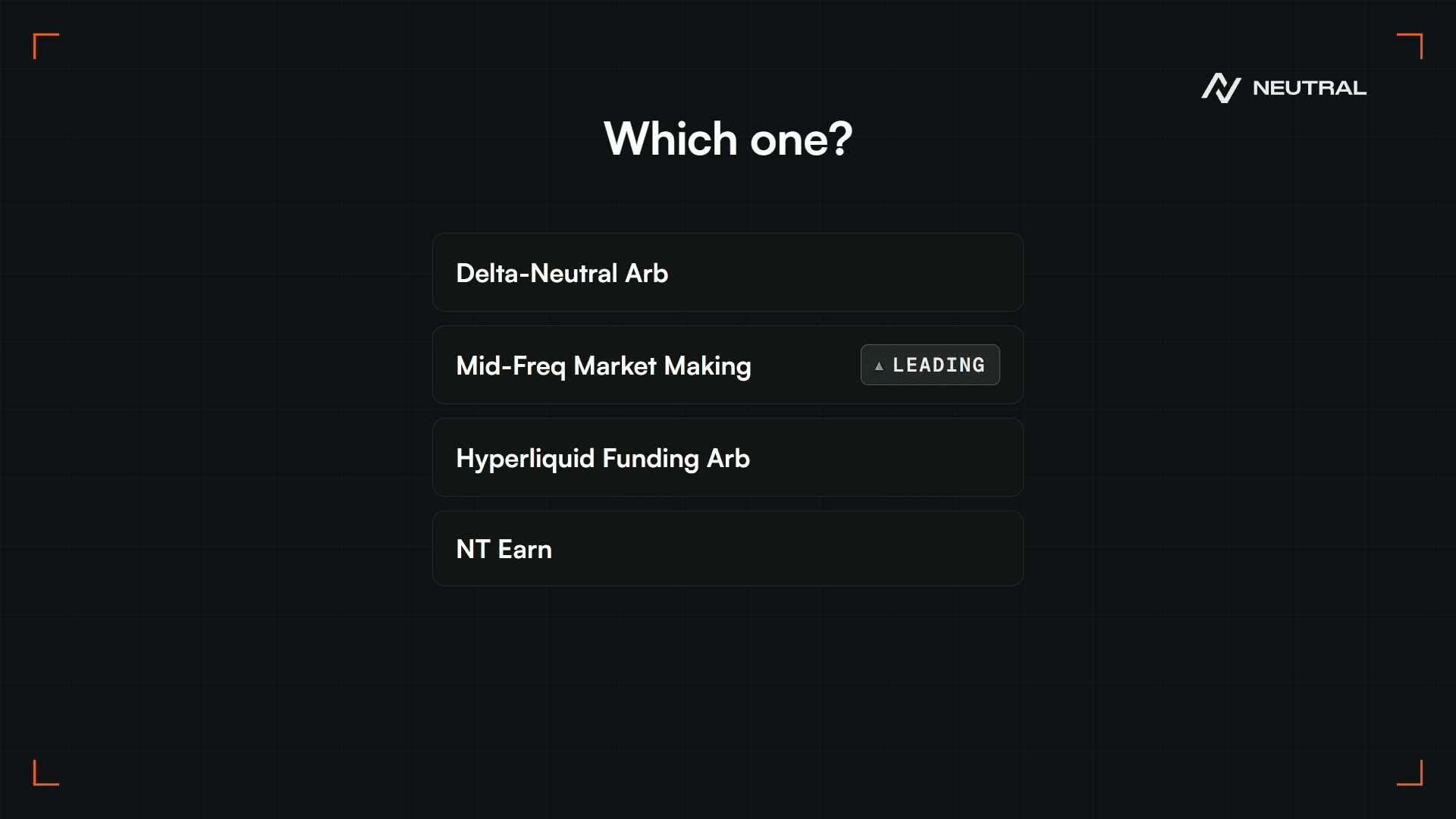
So we built Autopilot. One deposit, allocated across our live strategies and rebalanced as conditions change.
That is the product in a sentence. The rest of this is what sits underneath it, because in this market the underneath is the part nobody shows you.
What Autopilot Actually Does
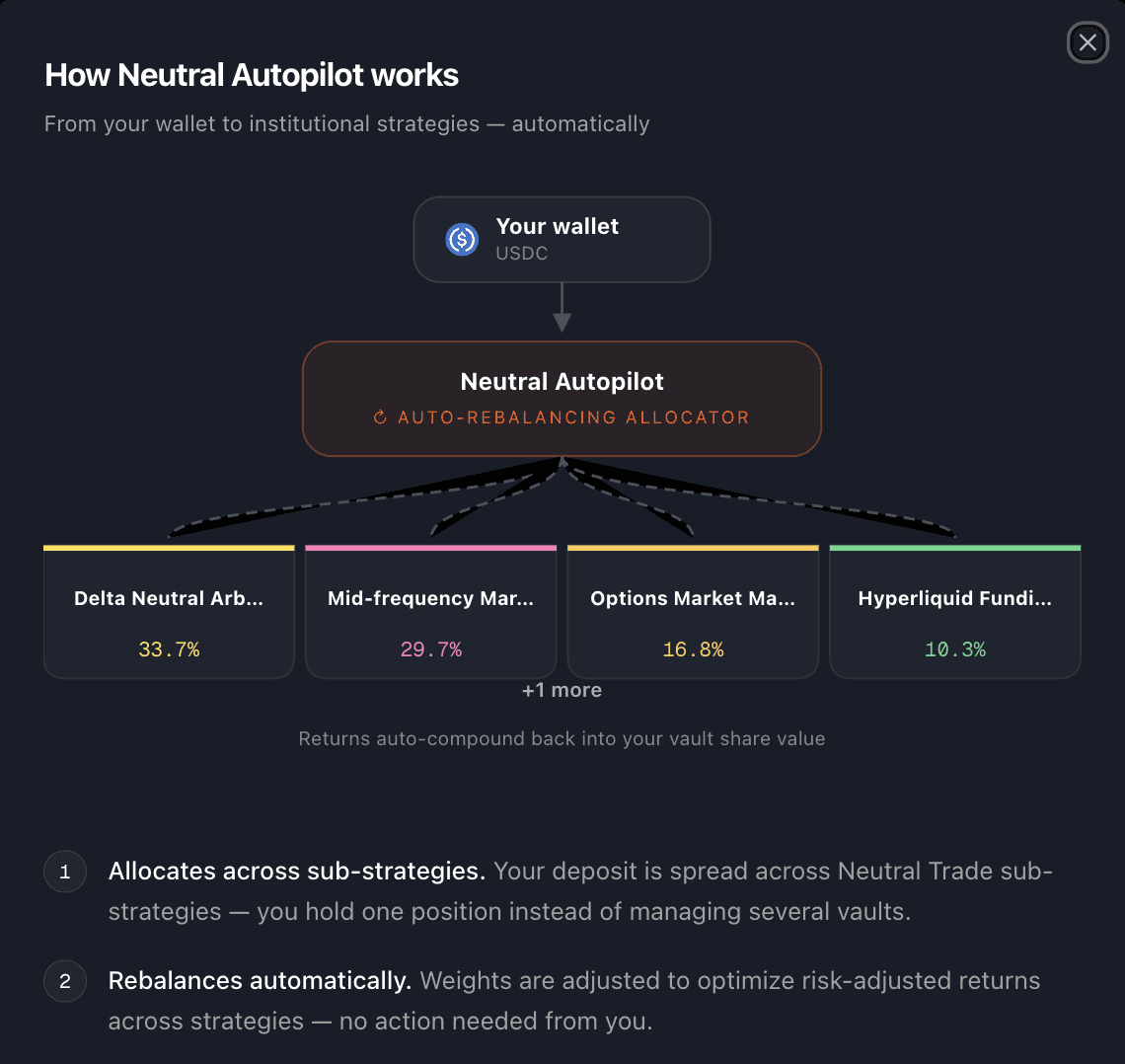
Autopilot is an allocator. Similar to a multi-strat hedge fund, it takes your deposit, spreads it across the strategies running on Neutral, and decides how much each one gets. When conditions change, it changes the weights. That is the whole job, and it is the job you would otherwise be doing yourself.
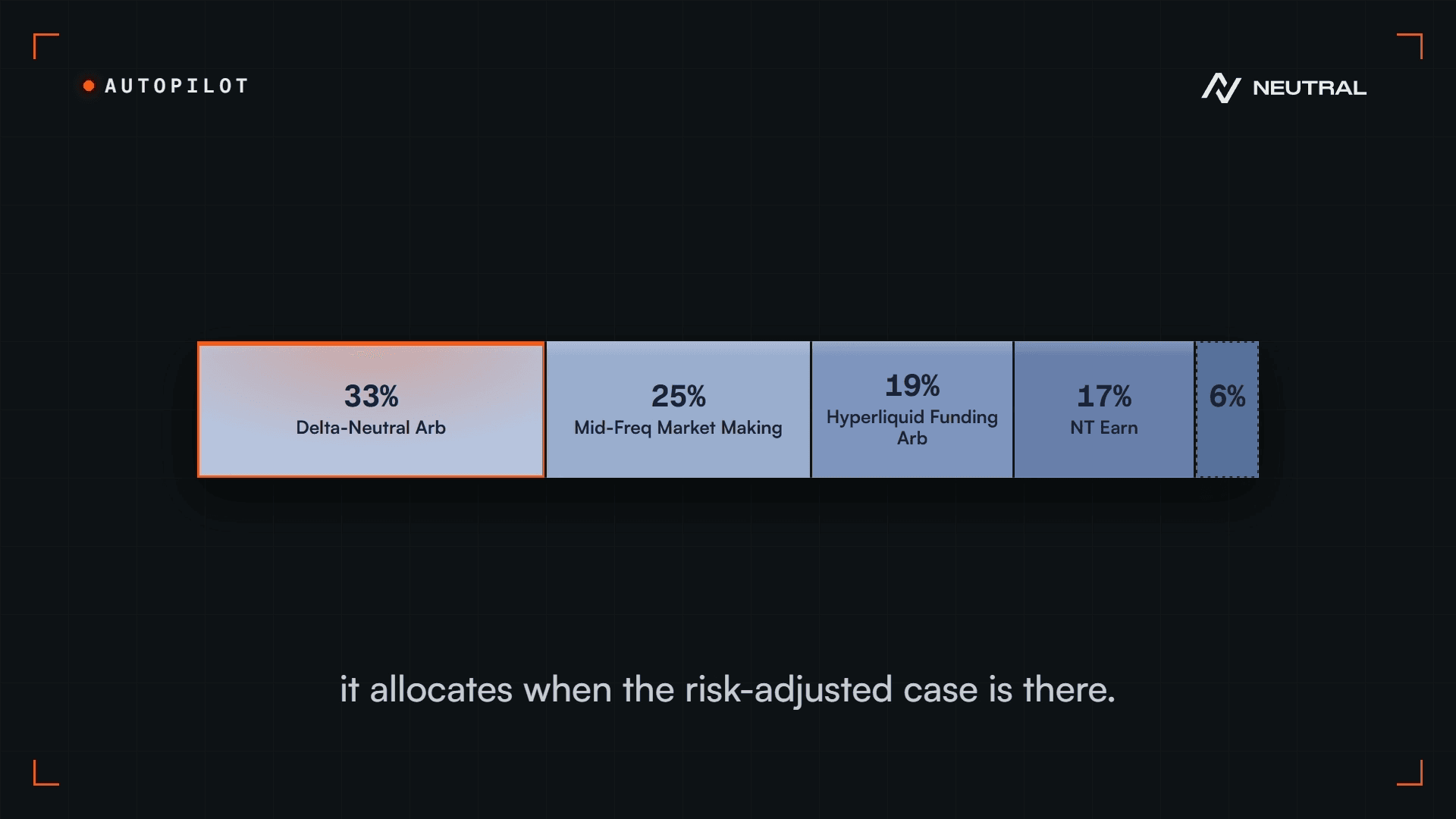
The set it can allocate to is not fixed. It grows as we list new strategies, and a strategy has to have run live on Neutral for a prolonged period before it can receive an allocation. Weights are recomputed constantly, but they only move when the expected improvement justifies the cost of making the change.
The core stays market-neutral. At most 5% can sit in directional strategies. Everything else earns from things that do not need the market to go up: the spread, the funding rate leveraged longs pay to stay long, price differences between venues.
Why Several Strategies and Not One?
A single strategy is a single edge. Edges decay when the trades get crowded (like everyone replicating our JLP Delta Neutral strategy when it first launched in 2024), and they decay for reasons specific to them: a spread compresses, a venue changes its fee schedule, somebody turns up with faster infrastructure. They are also conditional. The regime that suits one strategy is rarely the regime that suits another, and no strategy earns the same way in every market.
So we run a book of them instead. Different edges, sourced differently, that do not all depend on the same conditions holding. One desk's bad quarter should not be your bad year.
But collecting good strategies is not the same as building a portfolio, and this is the part I would underline. We track far more firms (80+) than we onboard (7 of them as of today), and every candidate gets measured against the book instead of on its own merits: correlation, asset overlap, what it actually adds. We will often choose a smaller uncorrelated strategy over a bigger one that overlaps with what we already run.
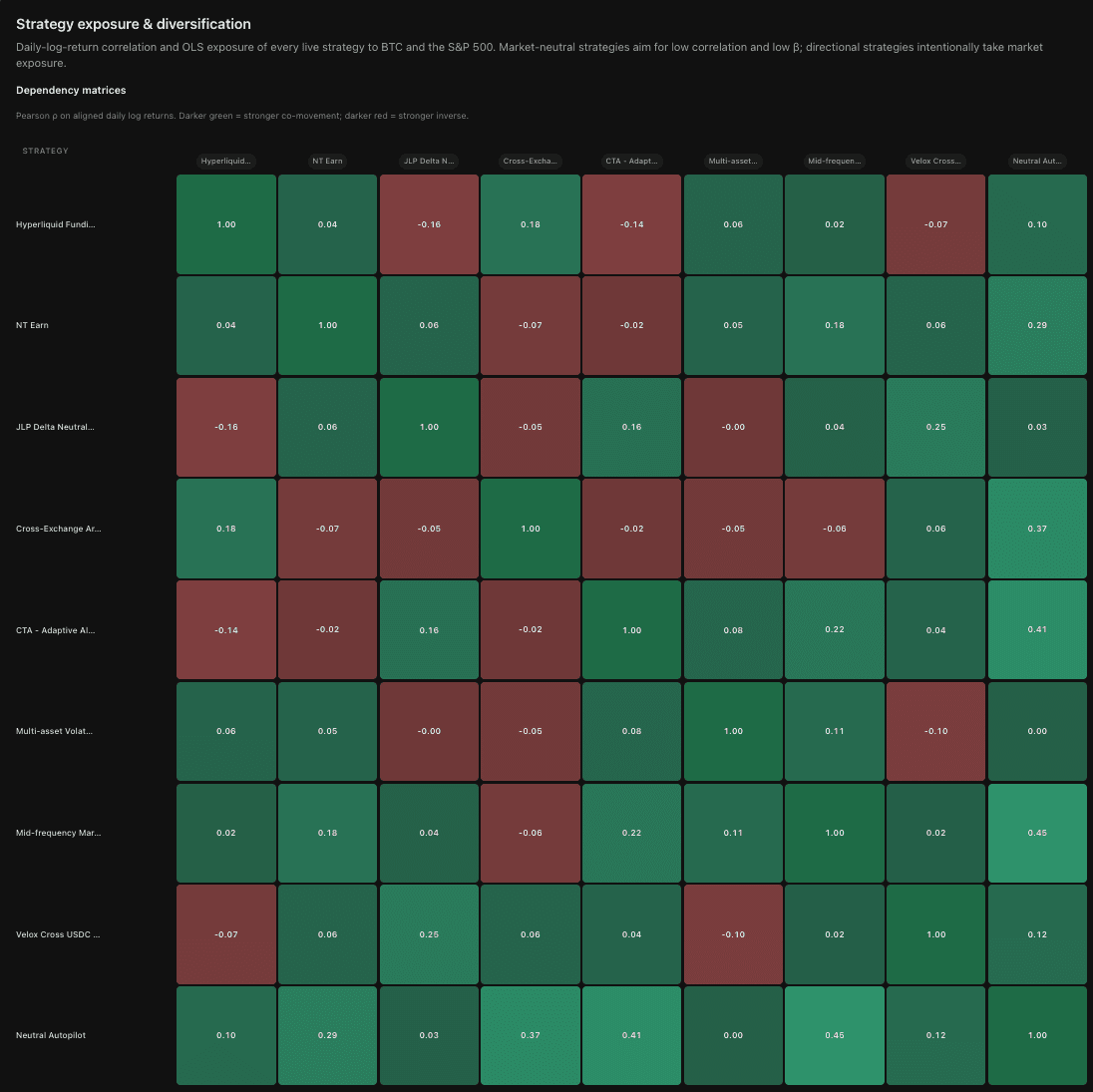
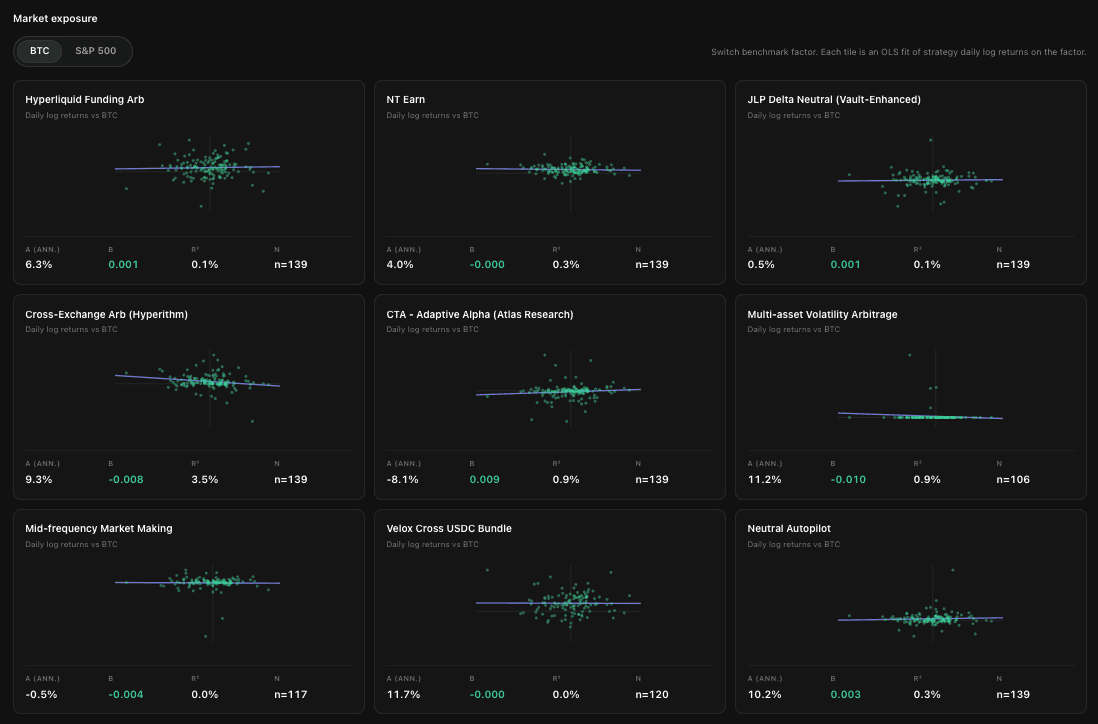
The question is never "is this strategy good?" It is "does the portfolio get better if we add it?" Those are different questions, and the second one is the whole job.
Security Considerations
1) The trading firm never custodies your deposits — they only get trade access rights
This is the one I would want to know first, and almost nobody asks it. When you deposit into a vault, where does the money actually go?
In many vault designs, it goes to the trading firm. That is not a vault. It is unsecured credit. You are lending to a trading desk and hoping they behave, and we all know how that hoping ends. 3AC last cycle. Stream Finance this one.
Be precise about what matters in those cases. Whatever the eventual findings, the structural problem was the same: transparency.
We verify instead of trusting. Live track records with daily PnL and timestamps, historical trade logs, and read-only exchange API access that we reconcile daily against what the firm tells us. Every firm goes through full KYB on the legal entity, and an unverifiable track record blocks onboarding outright, whatever else that firm has going for it. We have interviewed more than 80 trading firms over two years. Most of this job, it turns out, is saying no.
In addition, on Neutral Trade our partner strategy providers receive an execution-only sub-account. It can trade. It cannot withdraw. They don't take custody.
The collateral behind the centralised legs is not sitting on the exchange at all: it is held off-exchange at Copper and Ceffu and mirrored to the venue as margin, so an exchange failure does not take the collateral with it. On-chain operations run through Fordefi MPC with movement whitelists, fund movements are restricted to addresses we have pre-approved, and material changes to a vault sit behind a 12-hour timelock.
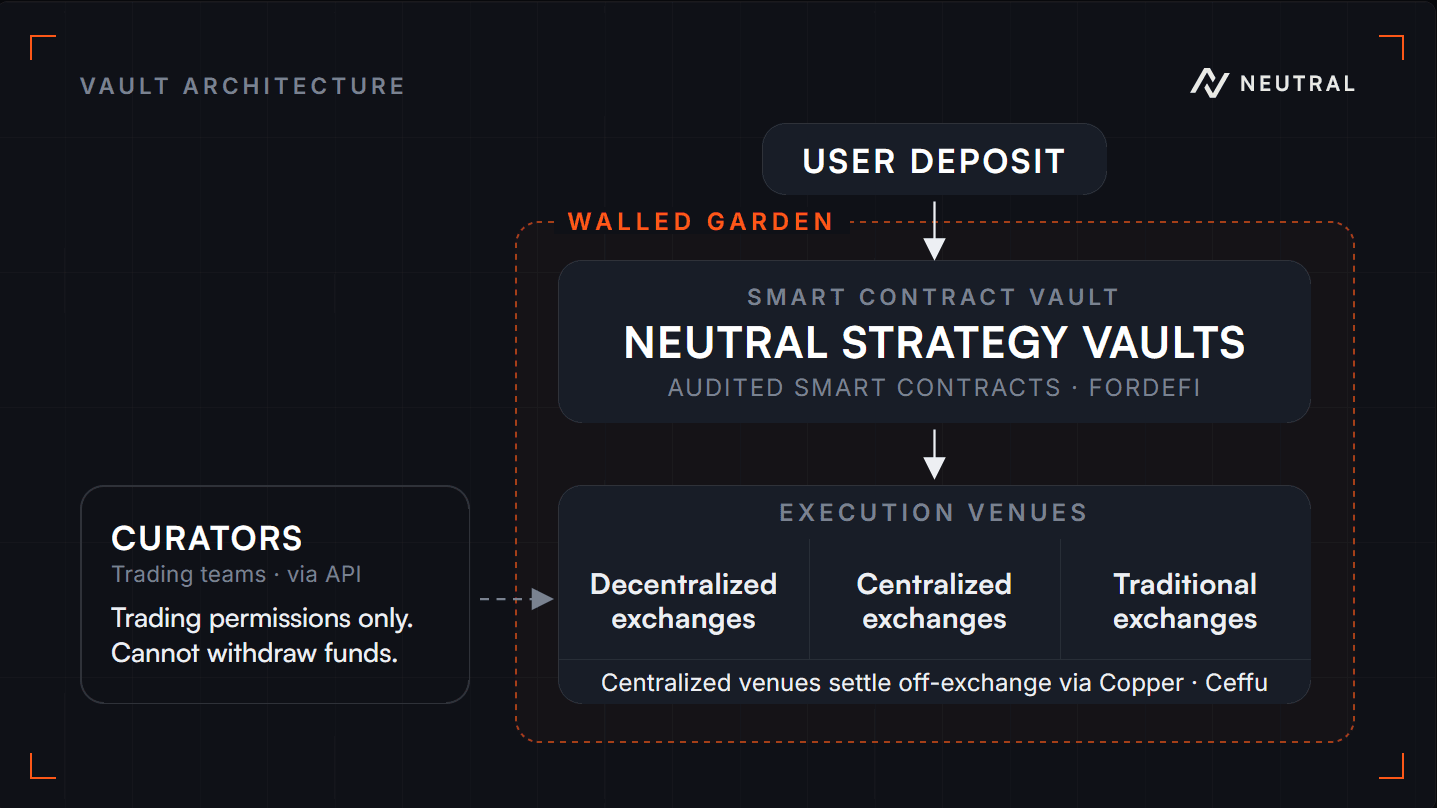
All of this took two years to build and I will be honest with you: it is the least marketable thing we own. But fund safety is one of those arrangements that costs you nothing at all, right up until the day it costs you everything.
2) Risk is contained by infrastructure
Our limits live where they cannot be negotiated: leverage caps, position limits, approved venues only, approved instruments only, all enforced at the infrastructure layer, not in a policy document. Autopilot additionally runs a hard cap on directional exposure. A trading firm cannot breach a limit it was never given permission to reach.
Every sub-strategy sits in its own isolated vault, so if one blows up, it doesn't take the others with it. We treat every vault as its own blast radius.
3) Audits
The strategy vault contracts are audited by Offside Labs, Quantstamp and Halborn (docs.neutral.trade/neutral-strategy-vaults/security).
Any smart contract upgrade requires a 12-hour timelock with a 3/5 quorum on isolated devices, following best practices in DeFi.
Real Transparency
Everything above is a claim. Here is where you check it.
Open the Autopilot page and scroll down. You get the live allocation. Every strategy in the book, the dollar amount sitting in it, and its share of the total.
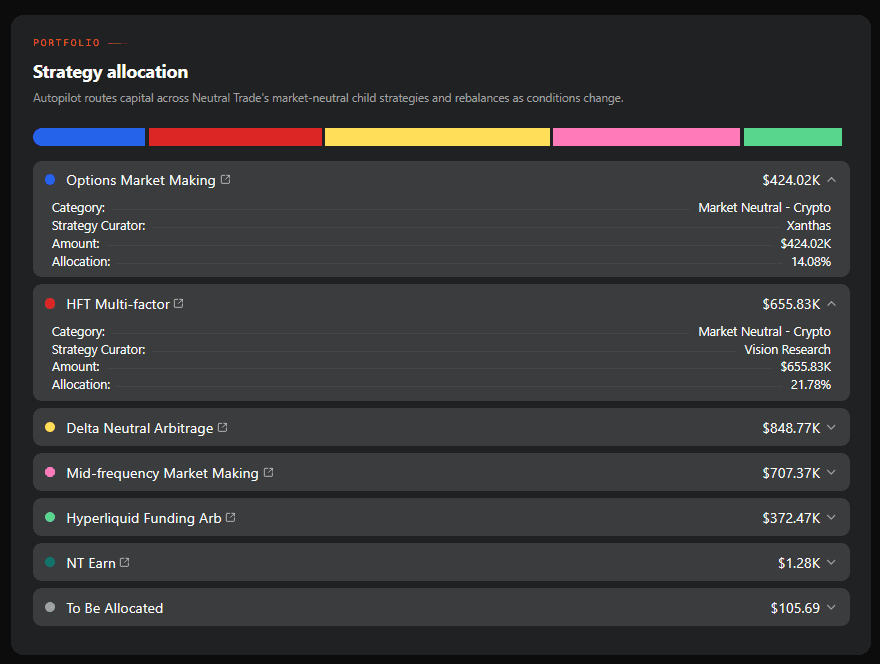
Below that is the risk telemetry, aggregated live from every child vault. How many assets are being traded and across how many venues. Which custodians are holding the collateral and in what proportion. How much is being traded on each exchange. Where the coin exposure lands on the market-cap curve, because a wide book is only diversification if the assets are liquid, and you should be able to check that yourself.
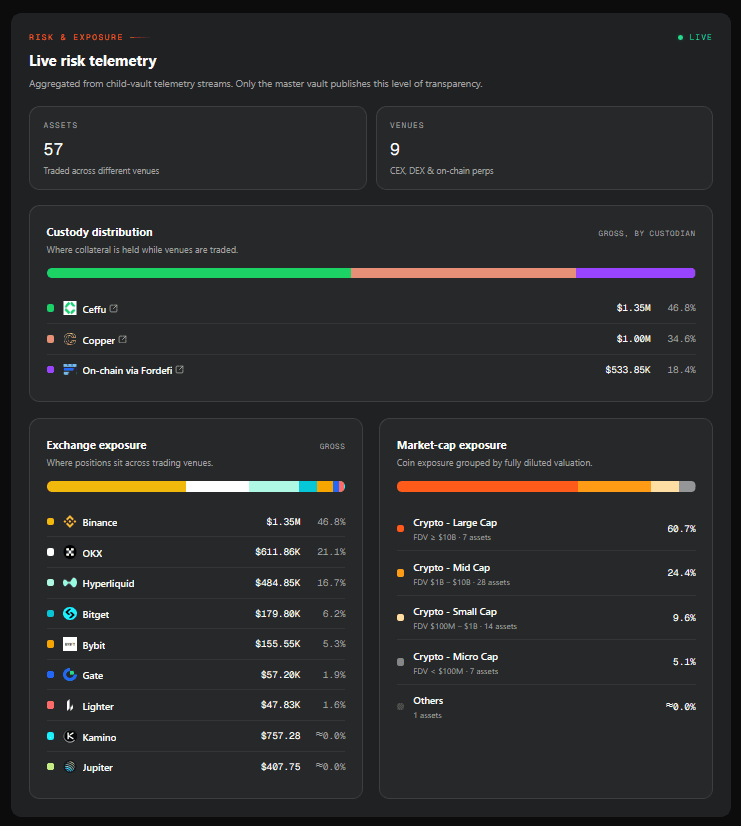
In addition, the NAV behind all of it is triple verified daily: Neutral Trade x the trading firm x Accountable. Read more about the data analytics here.
Why Strategy Vault Instead of Yield-Bearing Stablecoin?
1) All of your deposits are working
Now look at where the market's favourite yield structure comes from: the stablecoin plus staked-stablecoin design. USDe and sUSDe are the famous pairing, and the whole market has followed their mechanism.
The mechanics are simple — the yield is earned on the entire supply of the stablecoin, but it only gets paid out to the staked portion. So if half the supply is staked, the staked version prints roughly double the strategy's real return. Not because the strategy earned more, but because the holders who didn't stake are quietly paying for the ones who did.
And then there's the peg. When significant outflows come, redemptions arrive faster than the strategy can unwind, and the synthetic slips off its peg. Now the issuer has to defend it: paying market makers, renting liquidity, absorbing the spread. That money does not come from nowhere. It comes out of the same yield that was supposed to be yours, and in a bad enough week, the cost of defending the dollar outweighs everything the strategy earned and every commission collected.
Which raises a question nobody in that model enjoys being asked: why pay market makers to defend a peg, when you could simply hand the yield to the people who funded it?
We never took that problem on. Neutral has no peg to defend: no synthetic dollar, no market makers on retainer, no liquidity to rent. You hold a share of a vault, and the share is worth what the strategy is worth. It rises when the strategy earns and falls when it doesn't, and there is no third number in between that somebody has to spend your yield propping up.
A peg is a promise made in calm weather. We would rather not make promises the weather can break.
2) Transparent fee structure
Under a yield-bearing stablecoin, the issuer trades, the issuer marks its own book, and the issuer decides what you get paid. You have no way to check any of it. Suppose they earn 30% on your money and pay you 8%. That is a 70% cut, taken quietly, and nothing in the structure would ever tell you. You would see 8%, assume that was the strategy's return, and thank them for it.
For Neutral strategies, fees are stated up front and split explicitly between management and performance, between the strategy manager and the vault operator, published on every strategy page. Autopilot is free to access until 1 September 2026; a 1% annual fee applies after that date.
3) Paying a fair share of fees — on your own gains
Here's a problem most depositors don't even know exists, and it's a good example of the difference between building infrastructure properly and simplifying it because the proper version is hard.
In traditional asset management, performance fees come with a high-water mark: the manager only earns a performance fee on gains above your previous peak. Give back returns in a drawdown, and the manager earns nothing more until you've been made whole. It's the basic fairness mechanism of the entire fund industry.
Most DeFi vaults implement a simplified version: they crystallize fees every few days, with the high-water mark tracked at the vault level. One mark for everyone, keyed to the vault's own all-time-high share price.
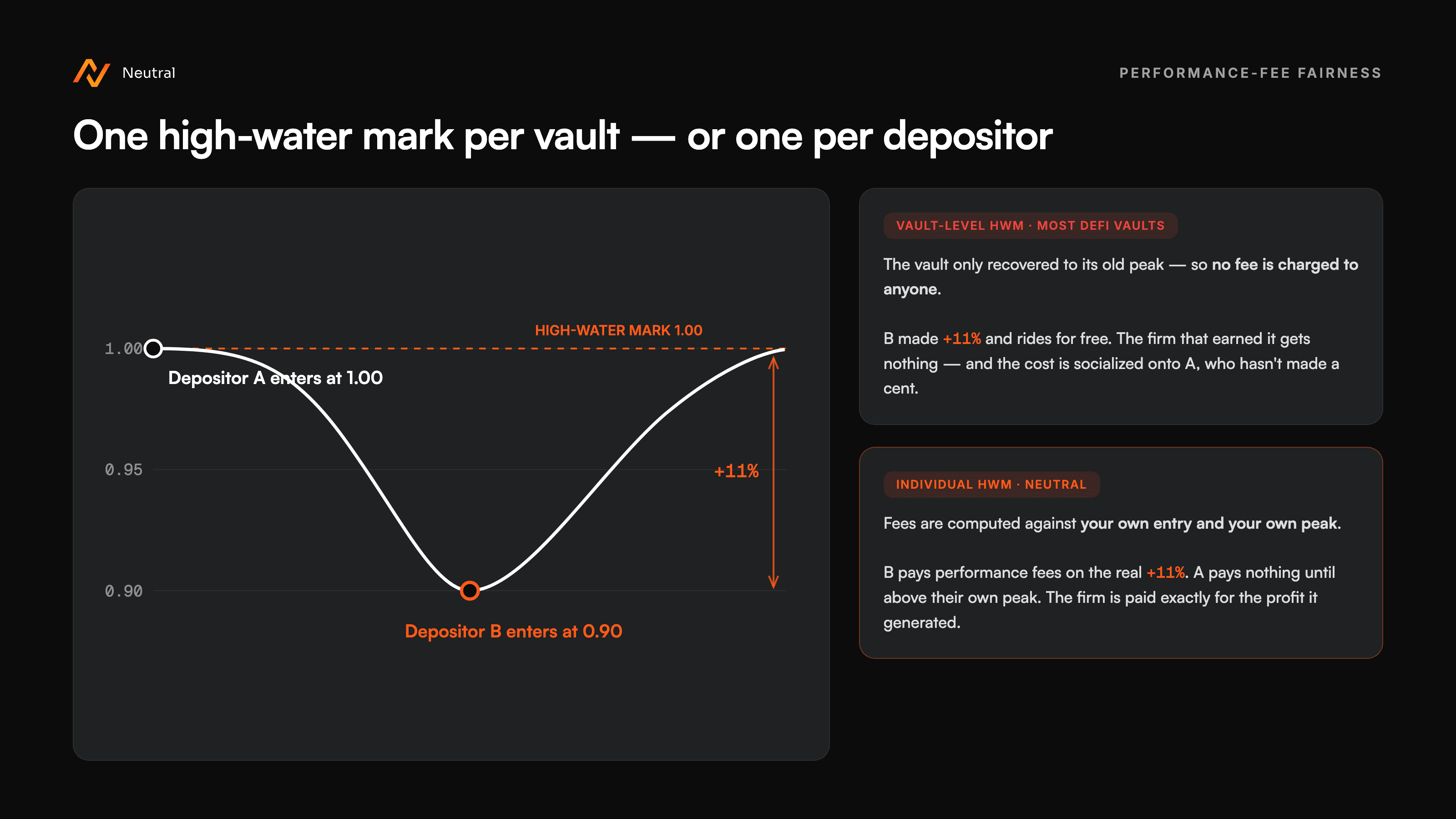
We built individual high-water marks instead. On Neutral, your fees are computed against your own entry and your own peak. Deposit during a drawdown and profit on the recovery, and you pay a performance fee on your actual gains. As you should, because for you they are actual gains. Sit through the drawdown, and you pay nothing until the strategy takes you past your own previous peak. The trading firm gets paid exactly for the profit it actually generated, no more and no less, and nobody's recovery is subsidised by anybody else.
This is meaningfully harder to build than a vault-level mark: it means tracking fee state per depositor rather than one number per vault. But "fair" and "simple to implement" turned out to be different things, and we picked fair.
This feature only applies to sub-strategies we allocate to via Autopilot. Autopilot does not charge any performance fees.
TL;DR
One deposit, spread across our live market-neutral strategies: cross-exchange arbitrage, funding-rate arbitrage, delta-neutral, market making, options. Run by professional quant firms, rebalanced and weighted as conditions change.
Every strategy is explained in full: what it trades, where the return comes from, what breaks it. The allocation ratios are visible on the page. If you'd rather build your own mix than let us allocate, you can do that too: deposit into the strategies directly and set your own weights.
Deposits are daily. Redemptions run on a weekly cycle with notice.
The launch announcement is on X.
This is what I think DeFi was supposed to be for. The good strategies should not be reserved for people who already have money, and the returns should come from real trading rather than from the next person who buys the token. That takes infrastructure somebody has to sit down and build. It is slower than launching a token, and it is the only version of this that lasts.
Are we just another yield platform? It looks the same. We are not the same.
Start earning with Autopilot →