Neutral Autopilot: Risk Management, Monitoring, Rebalancing & Strategy Allocation
How Autopilot monitors portfolio exposure, when rebalancing triggers, and how the optimization layer decides which strategies receive capital.
Neutral Autopilot manages risk at the portfolio level, continuously optimizing capital allocation across multiple strategy vaults.
Rather than relying on discretionary decisions or timing individual strategies, the system uses quantitative techniques to optimize capital allocation and maintains it through continuous monitoring and systematic rebalancing.
Portfolio Monitoring
Neutral Autopilot continuously tracks portfolio-level exposure and capital distribution, including:
- Net asset value (NAV) and pending capital flows for each strategy;
- Total portfolio TVL and the current allocation weight of each strategy;
- Deviations between live allocation weights and optimized target weights;
- Potential concentration risks or under-allocation risks caused by allocation drift.
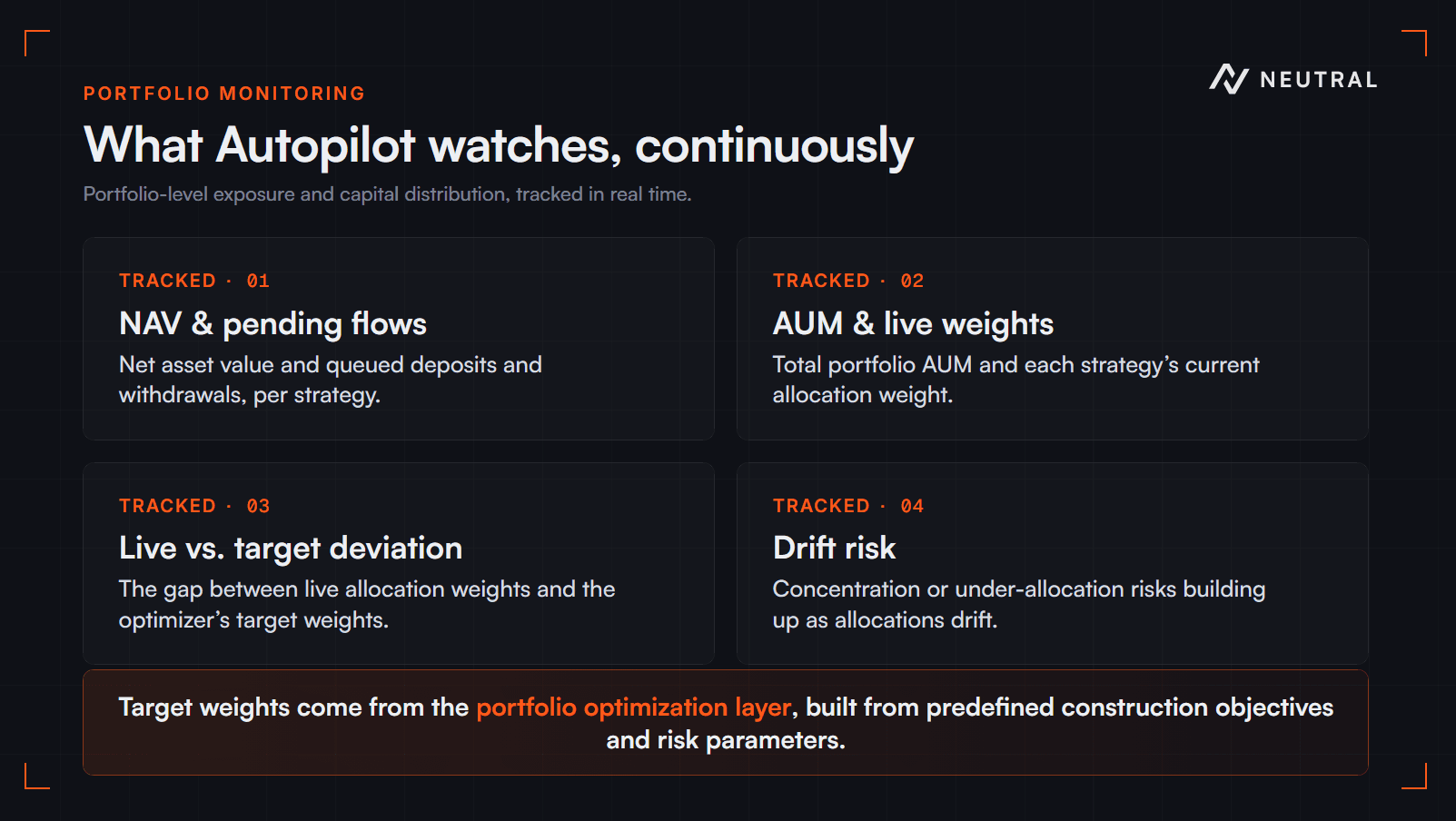
Target weights are generated by the portfolio optimization layer, which determines the optimal allocation across strategies based on predefined portfolio construction objectives and risk parameters.
Rebalancing Mechanism
Rebalancing is triggered when the live portfolio allocation deviates materially from the optimized target allocation, accounting for natural drift due to strategy returns.
To avoid unnecessary turnover caused by short-term market fluctuations, Neutral Autopilot applies a deadband mechanism that filters out minor allocation deviations below predefined thresholds.
When rebalancing conditions are met:
- Capital is withdrawn from overweight strategies;
- Capital is allocated to underweight strategies;
- The overall portfolio is gradually restored toward the optimized allocation.
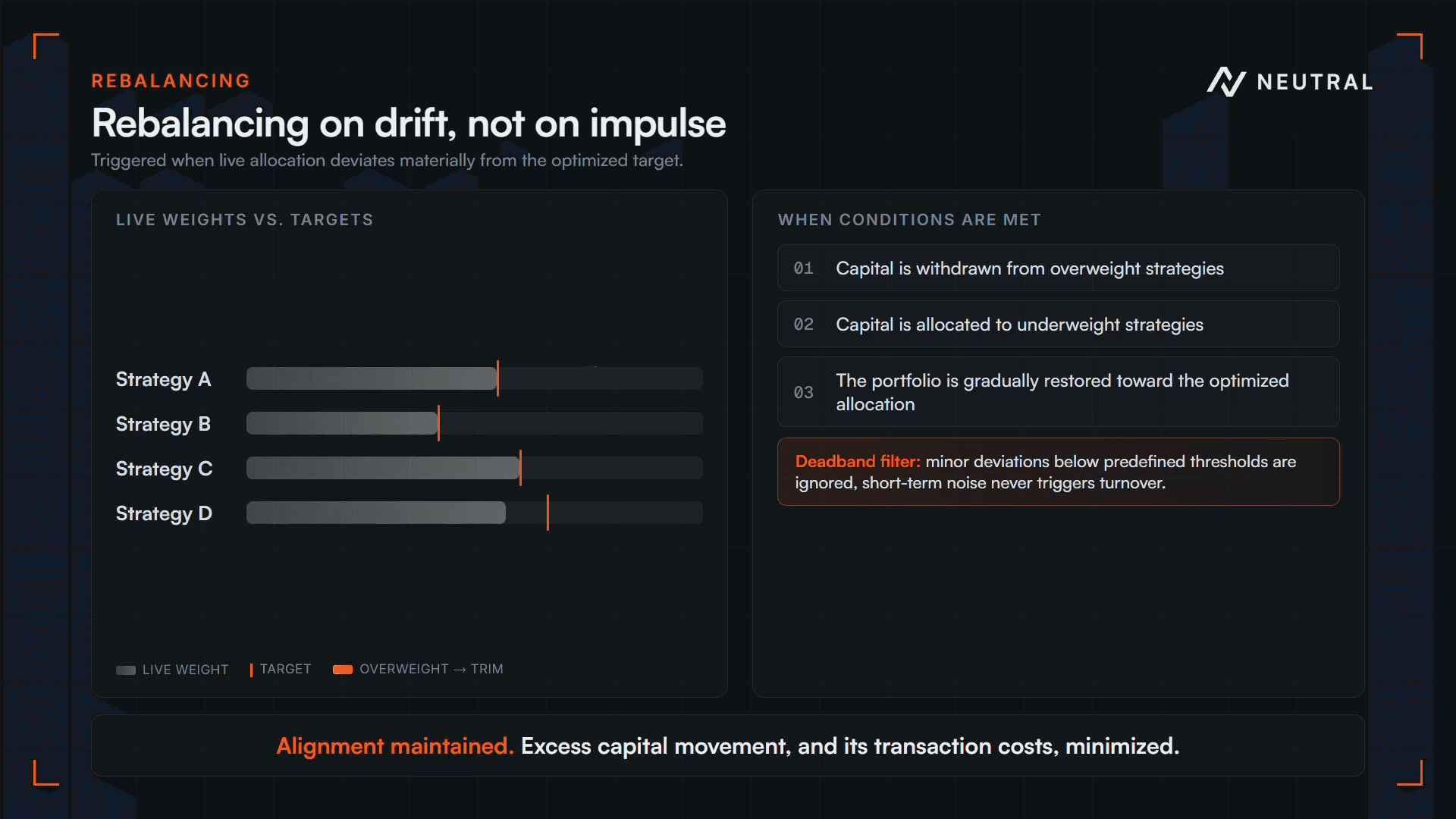
This approach ensures portfolio alignment while minimizing excessive capital movements and transaction costs.
Strategy Selection & Capital Allocation
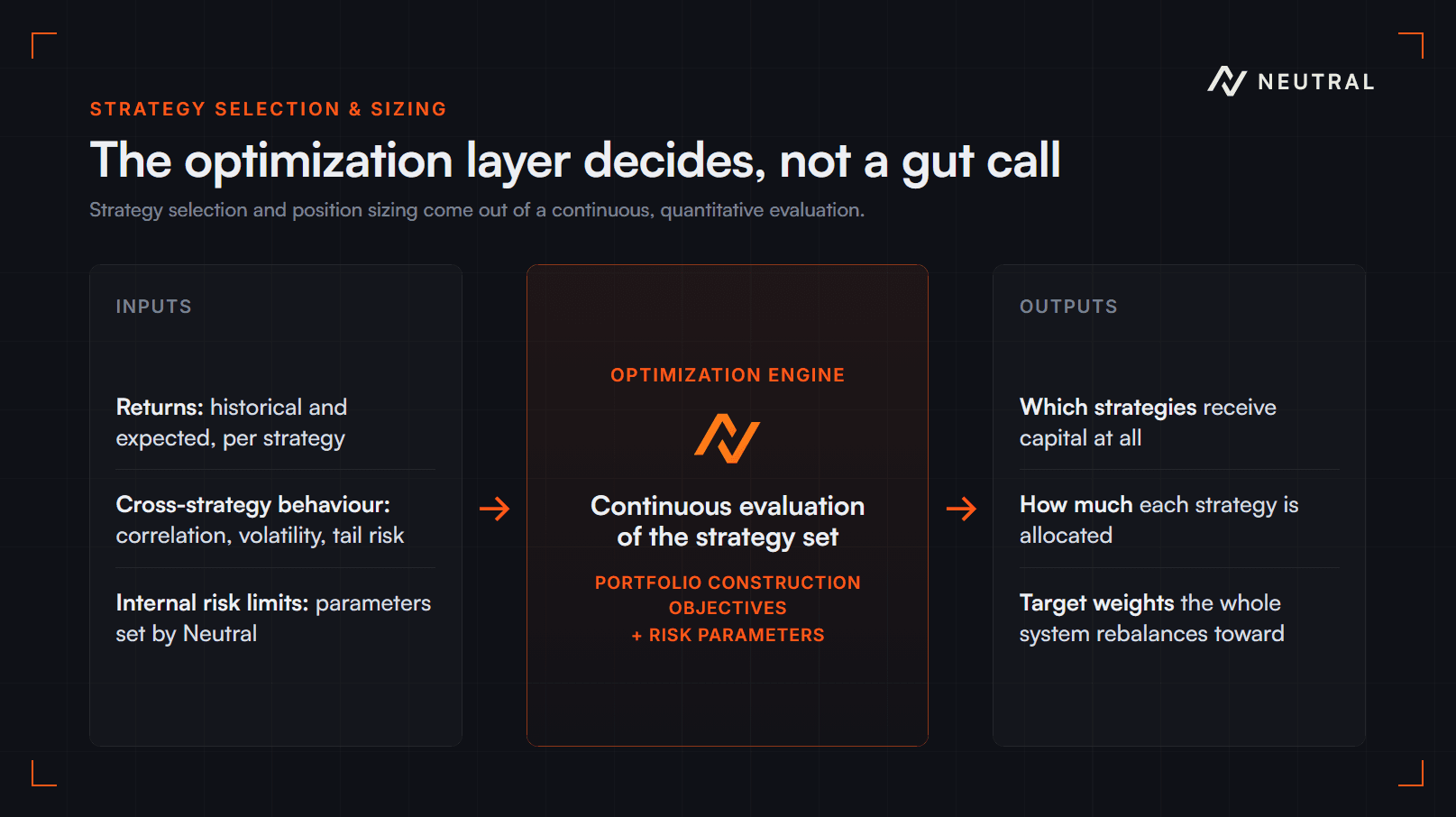
Strategy selection and position sizing are determined by the optimization layer. The optimization depends on:
- Each strategy's historical and expected return;
- Correlation between strategy returns, volatility and tail risk;
- Internal risk limits and parameters.
The optimization engine continuously evaluates the strategy set and determines:
- Which strategies should receive capital;
- The appropriate allocation size for each strategy.
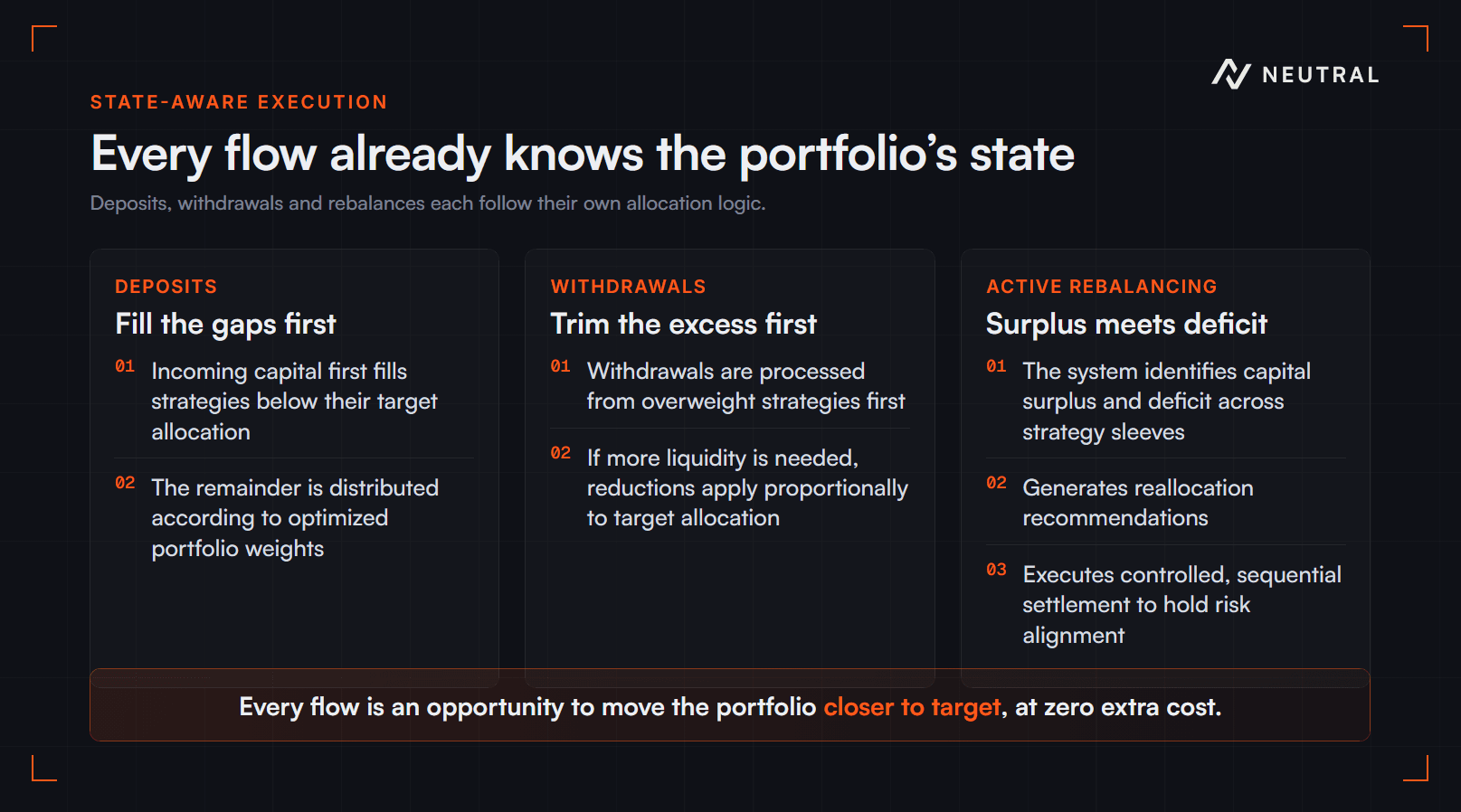
Execution follows a state-aware capital allocation process:
Deposits
- Incoming capital first fills strategies below their target allocation;
- Remaining capital is distributed according to optimized portfolio weights.
Withdrawals
- Withdrawals are first processed from overweight strategies;
- If additional liquidity is required, reductions are applied proportionally based on target allocation.
Active Rebalancing
- The system identifies capital surplus and deficit across strategy sleeves;
- Generates reallocation recommendations;
- Executes controlled, sequential settlement to maintain portfolio risk alignment.
Summary
Autopilot combines:
- Quantitative, model-driven capital allocation;
- Continuous portfolio exposure monitoring;
- Systematic rebalancing with cost minimization;
to maintain portfolio allocation within its designed risk framework while minimizing unnecessary turnover.
Start earning with Autopilot →